The URV highlights the figure of Antoni Rovira i Virgili, who, like the university that bears his name, had an interdisciplinary career marked by a commitment to influencing society to make it fairer and more open, more democratic, more cultured and more progressive
When the new public university of southern Catalonia was created in 1991 from the parts of the University of Barcelona that were already present in Tarragona and Reus, it was decided that the new institution’s name must both respect local sensibilities by avoiding any toponymical references and be worthy of what it was envisaged that the institution would represent. The name of Antoni Rovira i Virgili was thus chosen, in order “to honour the memory of the illustrious Catalan writer, historian and politician, one of the most important theorists and popularisers of the national cause of Catalonia, a former president of the Parliament of Catalonia and an example of civic-mindedness, hard work and esteem for the values of our people”, according to the text of the law by which the University was founded. Rovira i Virgili was also considered to be a figure with whom all the towns and cities in southern Catalonia could identify.
“He excelled in different fields. As a journalist, he edited newspapers and magazines, was a great writer, in politics he founded parties and presided over the Parliament, and as a historian he published many works,” explains Carod-Rovira
As can be seen in the official texts on its website, the University bears his name “with pride” and as “an expression of the values that guide it: the defence of democracy, public service, and social engagement and responsibility”. His “lifelong commitment to the national cause” and “a voracious intellectual curiosity” are also highlighted, as are the “political and social convictions that led him to personal sacrifice”.
UA theatrical tour delves into his figure
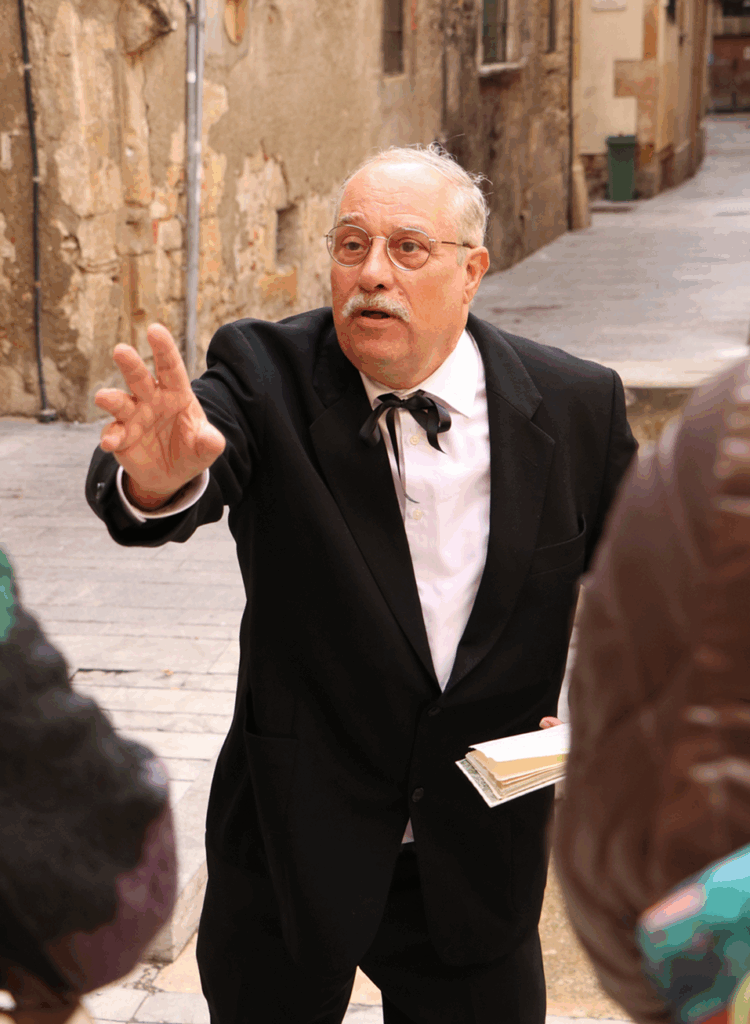
The Science Communication and Dissemination Unit of the URV’s Bureau for Communication and Marketing promotes a theatrical tour through the streets of Tarragona’s Old Town to commemorate the life and work of Rovira i Virgili. The tour lasts just over an hour and a half and takes in the most emblematic spaces in the city’s old quarter. At each stop, the audience discovers different moments that marked Rovira i Virgili’s life and thought. The route has been designed with the collaboration of experts on Rovira i Virgili and his era, and the man himself is played by the actor Jaume Martell.
Josep-Lluís Carod-Rovira is one of the foremost scholars of the life and work of Rovira i Virgili, and his highly detailed biography can be read in Antoni Rovira i Virgili i la Revista de Catalunya, a work published by Publicacions URV which brings together the papers from the conference on Rovira i Virgili organised by the Josep Anton Baixeras Chair at the end of 2024. Carod-Rovira emphasizes his stature and the fact that he was an intellectual who excelled in different areas. “As a journalist, he was the director of newspapers and magazines and put his name to thousands of articles; he was also a pioneer in international reporting and in turning opinion pieces into literary works. As a writer, especially in prose, he is up there with the greats alongside Sagarra, Ruyra and Pla. As a politician, he founded parties and went on to preside over the Parliament of Catalonia. As a political theorist he wrote mainly on the Catalan national question, and as a historian he published a great number of works.”
In her foreword to Antoni Rovira i Virgili i la Revista de Catalunya,Montserrat Palau, director of the Josep Anton Baixeras Chair, highlights “the importance of his contributions to different disciplines and his continued advocacy for a nation that would develop its own education policy at all levels and its own university research policy”, thus further justifying the choice of his name for the university.
Antoni Rovira i Virgili was born on 26 November 1882 in Tarragona’s Main Street to a republican-minded shoemaker from Sarral and a woman from Altafulla who ran a corsetry business. From a very young age, he moved in federalist, republican and left-wing circles, and began writing for various publications in Tarragona and Barcelona where he first studied Law and later moved to live. He also founded and directed a number of publications, some even at early age of 20. He worked for and contributed to El Poble Català, L’Esquella de la Torratxa, La Veu de Catalunya, La Publicitat and La Humanitat, among others, and in 1924 he founded the Revista de Catalunya. In addition, he founded parties such as the Catalanist Left, was a member of parliament for the Republican Left of Catalonia during the Second Republic, and was vice-president of the Parliament, before becoming its president in exile.

As an author of books and essays in the various fields he worked in, he was one of the most prolific writers during the first half of the 20th century in Catalonia. His many titles include La representació proporcional en el sufragi universal (1910), Història dels moviments nacionalistes (1912–1914), Diccionari català-castellà & castellà-català (1913), La nacionalització de Catalunya (1914), Novíssima ortografia catalana (1916), Gramàtica elemental de la llengua catalana (1916), Nacionalisme i federalisme (1917), Història de Rússia: des dels temps primitius fins als temps actuals (1919), the seven volumes of the Història nacional de Catalunya (1922–1934), the rather innovative biography Pau Claris: estudi biogràfic i històric (1922), Els polítics catalans: Enric Prat de la Riba, Ildefons Sunyol, Jaume Carner, Joaquim Lluhí i Rissech i Francesc Cambó (1929), Defensa de la democràcia (1930), El Corpus de Sang (estudi històric) (1932), Resum d’història del catalanisme (1936) and Valentí Almirall (1936). From the mid-1960s onwards, numerous collections of articles, publications of unpublished material and anthologies appeared.
He was, therefore, a figure with a very rich personal and professional background that aligned directly with the goals and principles of the new university. Despite this, he is probably not as well-known and valued as one might expect from such a packed CV; “when you touch on so many areas, even if you do them all very well, not everyone gets to hear about each of the positive things that you have done,” admits Carod, who adds that, “the modern-day ignorance of our own history is a great tragedy…in our country, where knowledge of history is rather sparse and historical memory too weak, the figure of Rovira i Virgili has perhaps not been valued as much as it ought to have been. He always used to say that without historical consciousness, you cannot have national consciousness.”
An exhibition showcases Rovira i Virgili’s legacy
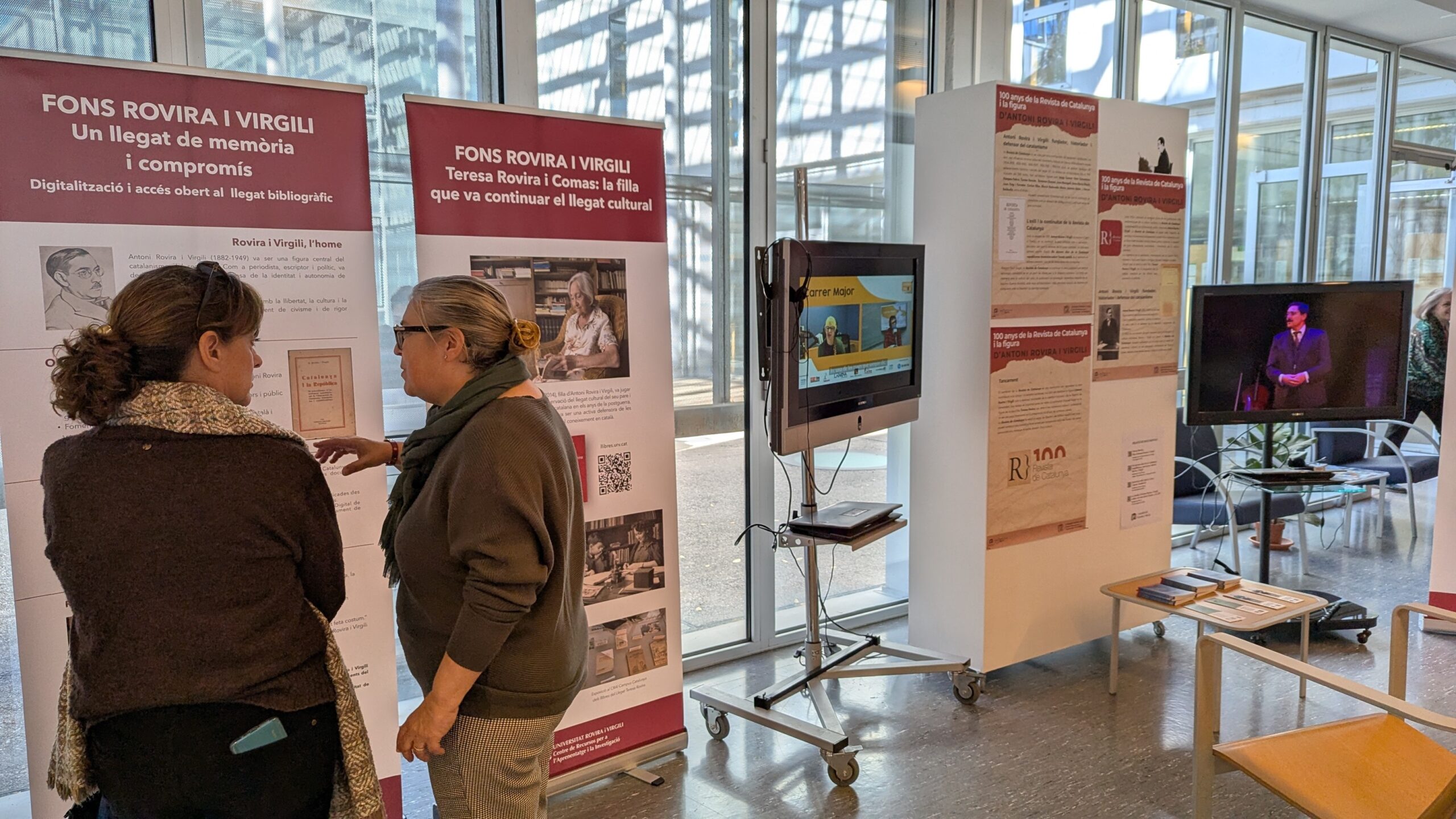
An exhibition is currently on display in the CRAI on the Catalunya campus (and then subsequently at other URV locations) to showcase and explain the works by Rovira i Virgili published by Publicacions URV, as well as the University’s entire collection of material on the author. The exhibition showcases the contribution by the journalist, politician and writer to Catalan thought through original documents displayed in display cases and through interactive and audiovisual material such as a video about the play “Els darrers dies” and a second one in which his daughter, Teresa Rovira, and his great-granddaughter, Maria Calvet, are interviewed.
What is definitely indisputable is Rovira i Virgili’s interdisciplinarity, as another expert on his work, Josep Maria Roig, former professor of contemporary history at the URV and director of the Revista de Catalunya, also recalls: “He was a multifaceted man who was difficult to pigeonhole. When we approach him, one of the things that surprises and makes us admire him is the sheer number of interests that he had as a person and as an intellectual.” To Rovira i Virgili’s various profiles, Roig adds those of cultural promoter, creator of civic platforms, editor and, even, poet and playwright, and reiterates that he was “one of the most prolific writers in Catalan of the contemporary era…He was truly what one would call a committed intellectual,” he concludes.
For his part, Jordi Ginebra, Professor of Catalan Philology at the URV, highlights Rovira i Virgili’s work as a linguist, centred on his two-pronged commitment to the Catalan language. On the one hand, both politically and on the basis of his own academic research, Rovira i Virgili “situates the demands for Catalonia’s linguistic rights within the context of the plurinational conflicts then existing in Europe and, on this basis, calls for Catalan to be given official status.” And, on the other hand, he considers the efforts of Pompeu Fabra to be key to the language’s progress and for this reason collaborates with him to defend and promote his work.
Jordi Ginebra also emphasises the depth of the democratic roots in Rovira i Virgili’s thinking and, therefore, his humanist leanings, which were “forged from the defence of a Catalanism based on democracy and on the right, dignity and freedom of individuals”. Ginebra considers that Rovira i Virgili’s definition of himself as a nationalist, which he reiterates is nothing more than a form of humanism, should not make anyone feel uncomfortable, despite the repression, social exclusion, supremacism and genocide committed in the name of nationalism during the 20th century. On the contrary, Antoni “fought his whole life for a fairer, more plural, more open and more tolerant society. For a society fully committed to democracy as a political system. A struggle that naturally included the defence of the freedom of the Catalan people”.
A game to test Rovirologists
Anyone wishing to test their knowledge on the figure of Antoni Rovira i Virgili can find an interactive game with various questions about his life and work on the URV website (the link is above the image.

For all these reasons, Rovira i Virgili “is a figure who needs to be reclaimed,” as Carod states, a view echoed by Montserrat Palau, who asserts that “there is a need to study and revisit the legacy of this multifaceted intellectual.” Ginebra adds that “the Universitat Rovira i Virgili must with pride bear the name of a person who fought for the recognition of the language and personality of Catalonia and, therefore, for freedom and justice”.
This is indeed exactly what URV does, as it not only takes pride in the person after whom it is named, but has gone further by revitalizing and promoting his legacy. For example, Publicacions URV, the university’s publishing press, has published various works by Rovira i Virgili, including In Defence of Democracy, L’Estat Català. Estudi de dret públic, Bref résumé de l’histoire de la Catalogne, Suite Rovira i Virgili and La victòria de Pompeu Fabra. The most recent have been the aforementioned Antoni Rovira i Virgili i la Revista de Catalunya, and the facsimile edition of Els darrers dies de la Catalunya Republicana, a work “fervently” recommended by Carod-Rovira as it bears witness to just how many Catalans suffered exile after the Civil War, as was the case with Rovira i Virgili himself, who lived in first Montpellier and subsequently in Perpignan, where he died in 1949. He is buried in Portús, “on Catalan soil but in the north, that is to say, in exile, so that the new generations do not forget that there were Catalans who died in exile defending their ideas and their country,” Carod points out.
The URV is also the guardian of the papers of Antoni Rovira i Virgili’s daughter, Teresa Rovira i Comas, which it officially received ten years ago, a collection that includes books on history, politics, grammar, dictionaries, readers, poetry, theatre and anthologies, all published from the early 20th century up to the Civil War. There are also works that he wrote in exile and published abroad (Argentina, Mexico and France). In addition, there are re-editions of his books from the 1960s to the present day and there are translations of early 20th-century English literature, works that he prologued, and magazines that he edited. These include books and articles that mention him, such as biographies, correspondence, bibliographies and studies on his political and ideological thought. Everything has been catalogued and is available for consultation at the CRAI.
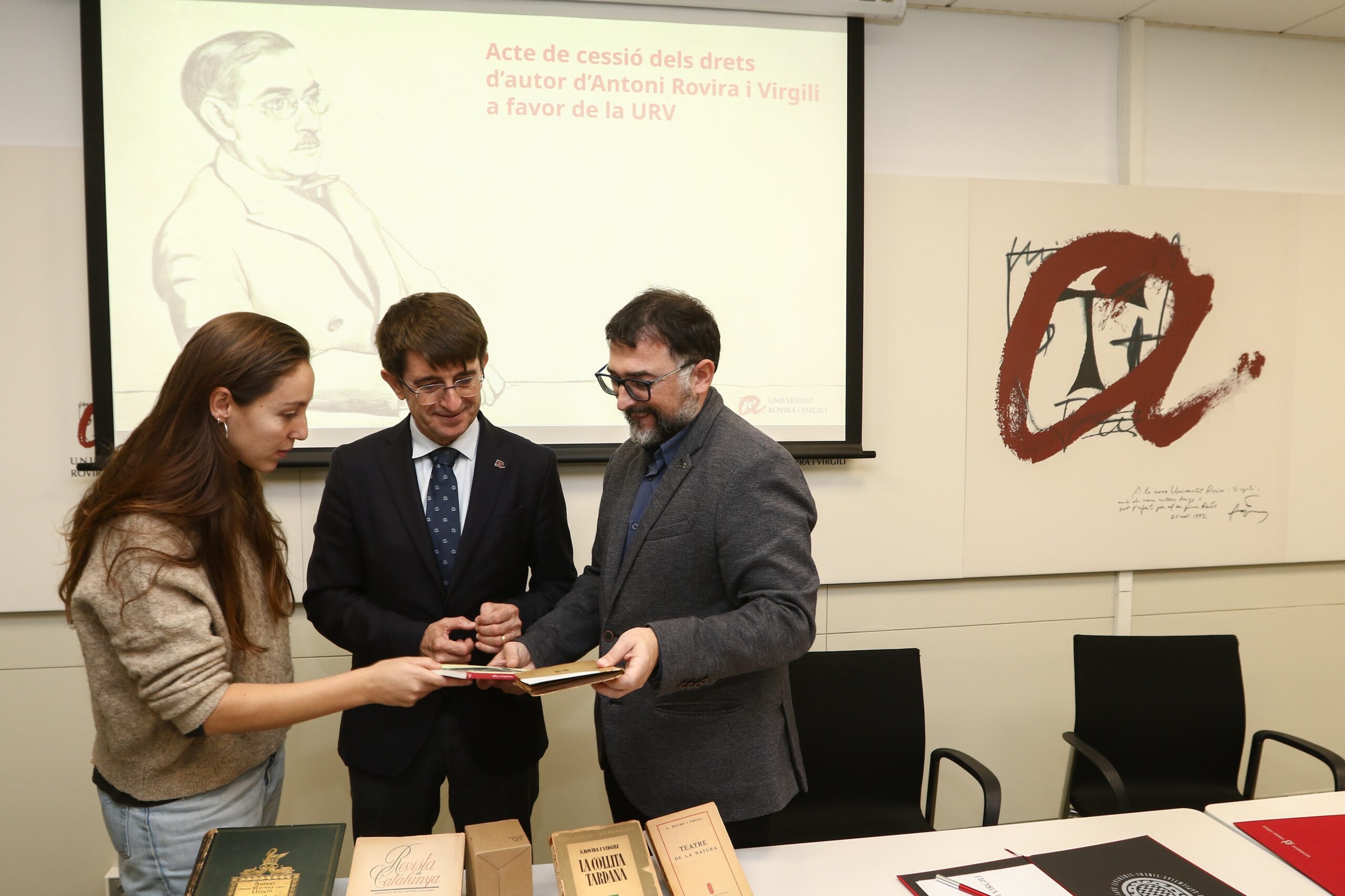
The URV also holds the publishing rights to Rovira i Virgili’s work after these were ceded to it by the family last year. These include the rights to reproduce and distribute all his works worldwide and in any language and this in turn allows the URV to continue preserving and disseminating his legacy and to digitize his work so that it is available for universal access. “The family is very grateful to the University, because my grandmother’s aim was to keep alive the testimony of those who had to go into exile and to build a collective history,” said Maria Calvet, Rovira i Virgili’s great-granddaughter during the rights cession ceremony. She expressed her gratitude and trust in the University’s efforts to disseminate and promote her great-grandfather’s work.
Therefore, the URV carries and promotes the name of a man whose legacy needs to be revitalised and reinvigorated; but it does not stop at his name, but rather endeavours to make his legacy its own by preserving it and making it available to anyone who wishes to find out about an intellectual who, like the University, is interdisciplinary and persevering in the challenge of creating a fairer, more democratic, more cultured and more advanced society.