The URV is leading the way on the key issue of equality through the application of a new protocol that speeds up communication in situations of discrimination and harassment, whilst at the same time attracting more and more girls to STEM careers thanks to its constant promotion and awareness-raising
“These awards are the icing on the cake after the many years of hard work by the Equality Unit, especially through its equality plans. Although there is still work to be done, such as reducing the pay gap and increasing the presence of women in senior management positions, the impact of the URV’s gender equality policies continues to be ensured by a strong and long-term institutional commitment,” explains Cilia Willem, director of the Equality Unit.
When the URV approved its the first Equality Plan in 2007, it became a pioneering university in Catalonia and Spain. That first plan came off the back of the findings of a report presented months earlier, La desigualtat d’oportunitats per raó de gènere a la URV, which highlighted situations of inequality and discrimination against women that needed to be changed. That first Plan (2007-2010) was followed by two more (2011-2019 and 2020-present) which had measures aimed at eliminating discrimination and resolving imbalances at the University. The nature of these plans meant that the progress made after applying the measures was evaluated, shared and made public. On the basis of this publicly available information, external bodies were able to see the URV’s high level of compliance with its own road map of actions, which in turn led both to the URV receiving the award from the European Union and being ranked by THE magazine in 47th position out of 1,361 universities around the world in terms of gender equality.
A more inclusive university
“These awards are the icing on the cake after the many years of hard work by the Equality Unit, especially through its equality plans. Although there is still work to be done, such as reducing the pay gap and increasing the presence of women in senior management positions, the impact of the URV’s gender equality policies continues to be ensured by a strong and long-term institutional commitment,” explains Cilia Willem, director of the Equality Unit.
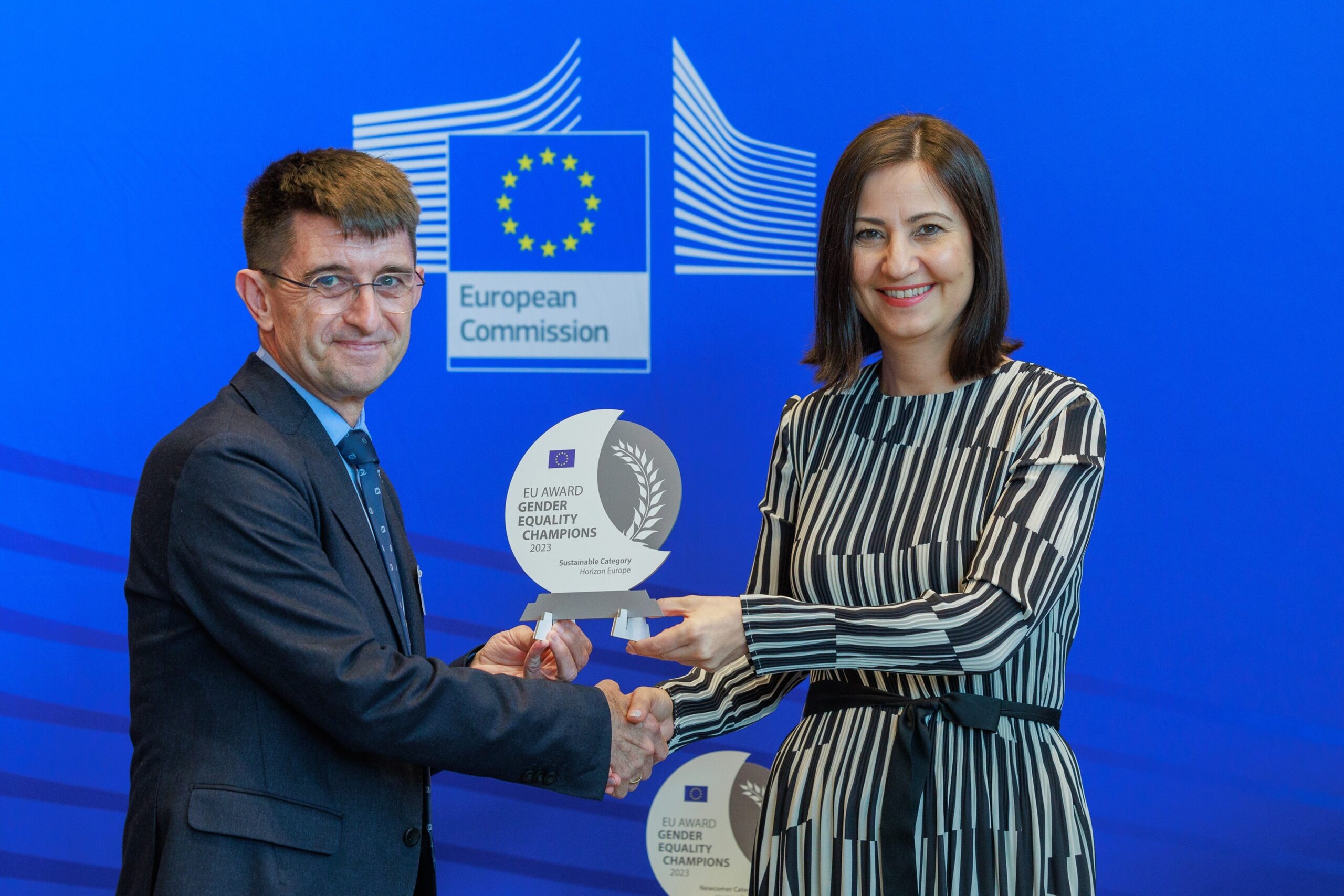
The Rector of the URV, Josep Pallarès, receives the EU Gender Equality Champion award from the European Commissioner Iliana Ivanova.
In 2020, the URV reaffirmed its commitment to gender equality by creating the Equality Unit, which is responsible organising training, promoting awareness-raising campaigns, collecting data and supporting the equality councils at all its faculties and schools. It also carries out periodic diagnoses of the state of equality through its Equality Observatory and is responsible for designing, implementing and evaluating the current Equality Plan, which aims to implement positive actions to eliminate discrimination in all areas of the University and to ensure equality among all people in its community. The plan focuses on five areas: commitment to gender equality, diagnosis of sexism, equality of conditions in access to and organisation of work, promotion of the gender perspective and consolidation of the role of women in science.
As a result of this, the URV continues to make progress in terms of the presence of women in different groups. Particularly significant is the improvement among the teaching and research staff (PDI), the group with the greatest gender imbalance until now and where progress is being made towards parity. For example, in 2012 women accounted for 41% of the URV’s teaching and research staff, whereas by 2023 this figure had risen to 49%. Throughout the university community as a whole, women account for 58% of the total, three points above the average for both Catalan and Spanish public universities.
The URV is making progress in terms of the number of women in different groups, with particularly significant improvement among teaching and research staff
However, there continues to be a gender pay gap and a lack of women in leadership positions and among both staff and students in the STEM (Science, Technology, Engineering and Mathematics) departments, despite the slight increase in the number of female students in recent years. It is towards these issues that the Equality Unit is now focusing “the work that still needs to be done”, according to Cilia Willem.
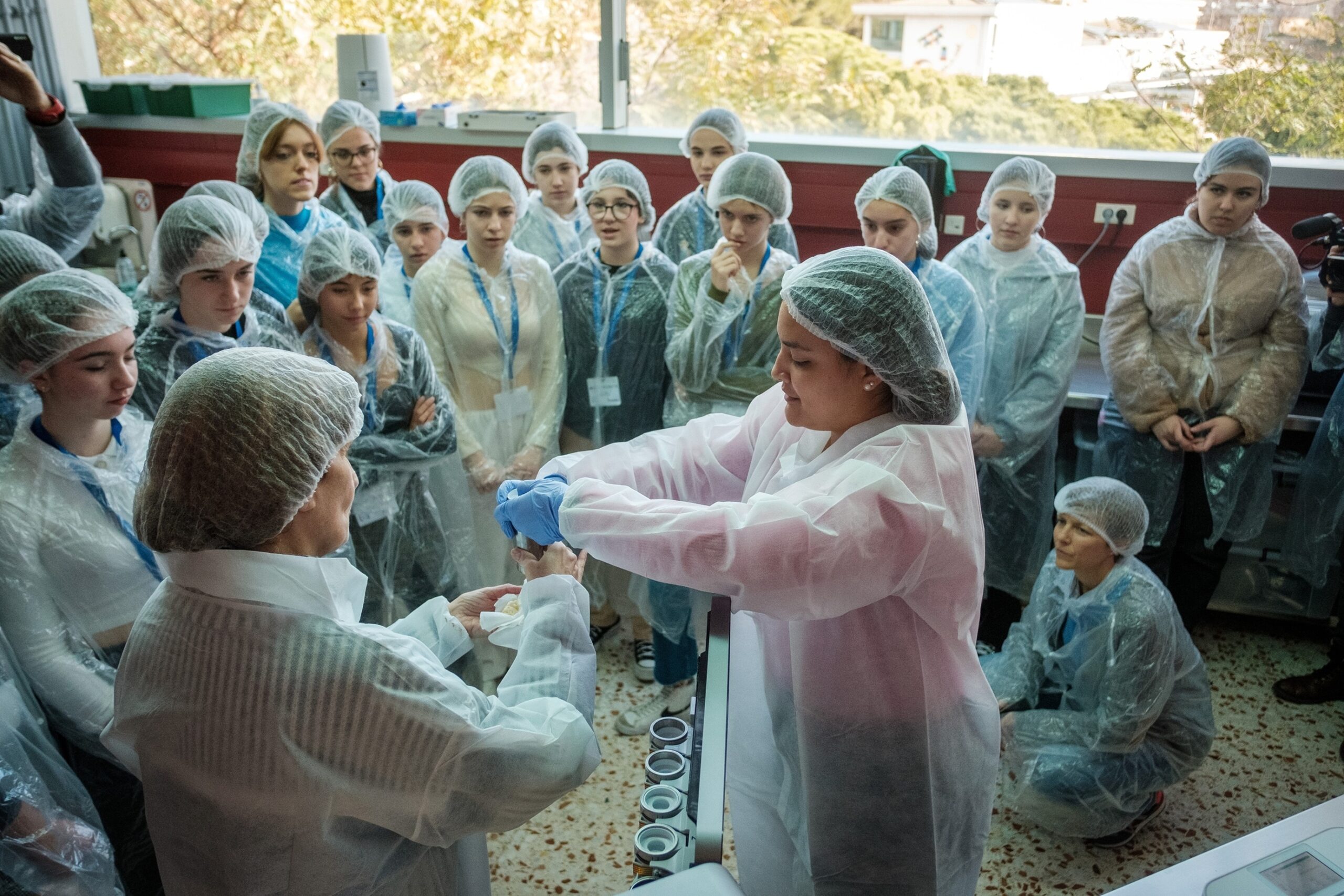
Several secondary school students follow the talks given by two URV researchers during Girls’ Day.
One of the activities organised by the Equality Unit to increase female representation in traditionally male-dominated sectors is Girls’ Day, which aims to inspire girls at secondary school to choose to study STEM subjects. With the collaboration of the School of Engineering and the School of Chemical Engineering, Girls’ Day is held every year around 11 February, which is the International Day of Women and Girls in Science, and involves talks, workshops and various events to promote the role of women in research and thus try to reverse the figures that often have them in second place.
These actions will bear fruit in the medium and long term, so it is difficult to measure their immediate impact, admitted Cilia Willem, who nevertheless pointed out that they are fighting against cultural influences that have to be worked on even at primary school level, “where it is detected that girls are still perceived as less intelligent and teachers, unconsciously, often give different treatment to children”.
Research into equality
There are many research groups at the URV that carry out research with a gender perspective on topics such as sexual diversity, discrimination against women, gender violence, etc., especially in areas such as education, law, anthropology and communications. For example, an interdisciplinary research team is currently working on three complementary projects that investigate the consequences of feminicides on the children and relatives of the victims, the judicial treatment of cases of gender violence, and the care model for sexual violence in childhood.
However, the situation is definitely improving given that, for example, at the URV in just five years there has been a notable increase from 24% to 52% in the number of women leading the 87 research groups recognised by the Catalan Government. The number of female honorary doctors and women participating in special events, such as inaugural lectures, is also continuing to rise. The fact that both girls and boys have more and more role models is key to inspiring them in their choice of career.
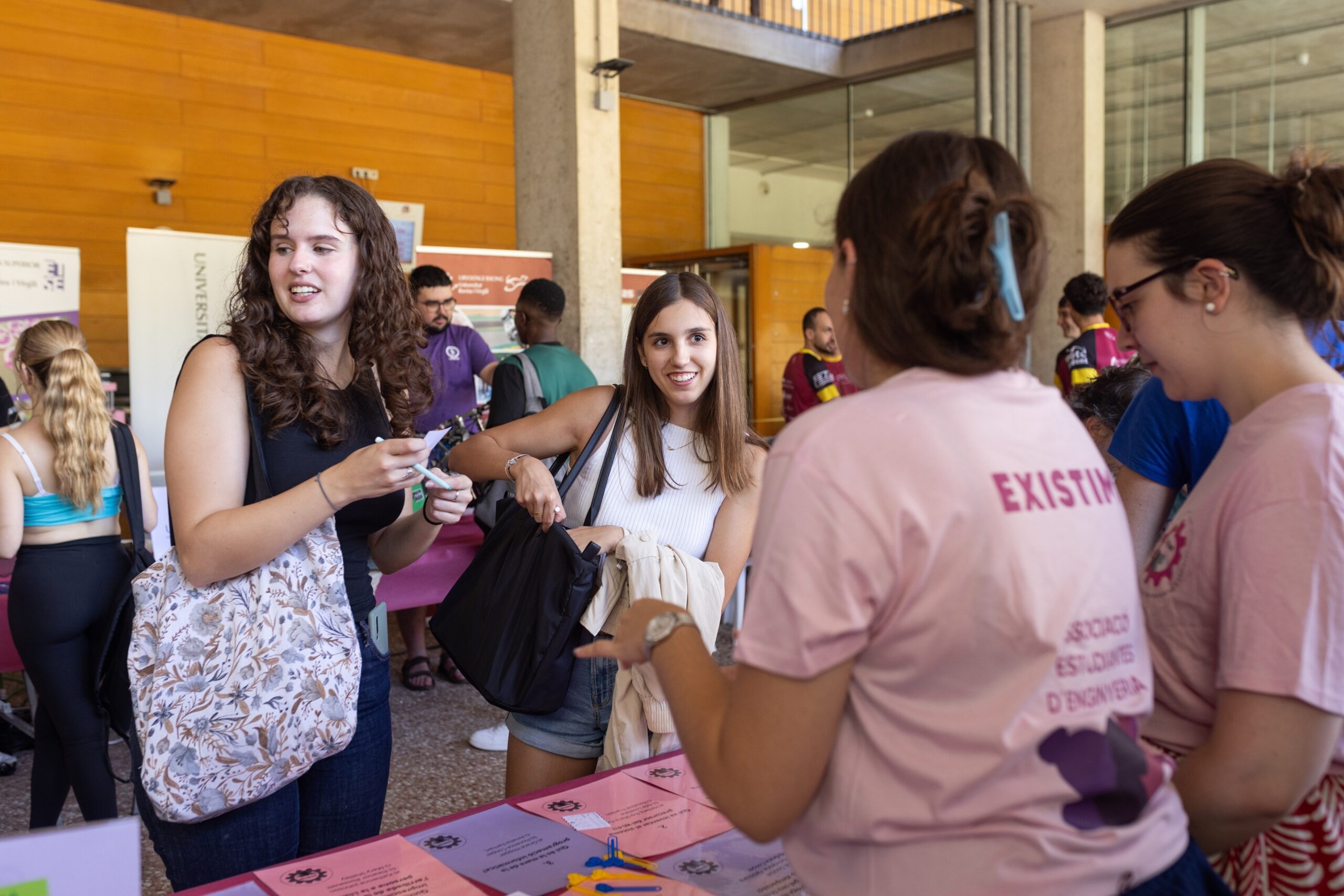
The students are also leading the way in this regard, through the creation of initiatives such Existim-Associació d’Estudiantes d’Enginyeria (We Exist-Association of Engineering Students), an organisation that aims to promote gender equality in engineering, challenge stereotypes and give visibility to the women involved in this field of knowledge. The association has set itself the objective of promoting engineering among young women and encouraging interactions between girls from different disciplines within the university.
A safer university
With regard to the fight against gender-based discrimination, harassment and violence, the URV has recently approved a new protocol for prevention and action that is “much more flexible and clearer and unified for the entire university community”, explained Cilia Willem. Until now, the URV had a protocol for gender-based violence and violence against student members of the LGTBI community and another protocol for cases of harassment of or violence towards URV staff in the workplace. The new protocol covers the entire university community and focuses on sexual harassment and harassment motivated by gender, sexual orientation, gender identity and gender expression.
Representatives of the We Exist-Association of Engineering Students give information to first-year girls at the Welcome Space for new students.
The protocol’s lines of action range from prevention and awareness-raising to the monitoring of cases and evaluation of actions, with special emphasis on support and reparation of damages. Thus, all members of the URV must act diligently to prevent and avoid situations of harassment. The institution, for its part, is committed to promoting awareness-raising actions, ensuring that new study plans include specific training regarding what constitutes violence, allocate resources for support and reparation measures, and provide the Equality Unit with adequate human and material resources to carry out its work.
The protocol goes from prevention and awareness-raising to the monitoring of cases and the evaluation of actions, giving value to its efforts to provide support and ensure reparations for those harmed
It is also necessary to ensure there are purple and multicoloured attention points at the events held at the University. “These are points on different campuses and faculties where people who have suffered sexual or gender-based harassment, or who have been witnesses, can report the incident using a QR code,” Willem explains. Most of the events organised by the URV, such as the URV festival, also have purple points.
The gender perspective and inclusive language in the classroom
The Equality Unit has initiated a project to introduce the gender perspective to teacher training courses to prevent the biases that commonly occur in the classroom, for example, by including more women in reading lists or debunking prejudices such as the fact that boys are less shy when it comes to speaking in class or that they are more skilful at some processes. In addition, the Equality Unit is also preparing a guide on how to use more inclusive language at all levels.
The purple points can also be used to make complaints or suggestions, which are then passed onto another element of the Equality Unit, the equality councils, which after three years of operation now have more than 60 members. “These are informal groups, specific to each faculty, led by an official figure who is the head of equality at each centre. The fact that the equality councils are distributed throughout the different faculties means that they can keep abreast of everything that happens and the needs that arise in terms of equality. Were this not the case, it would be more difficult to carry out this work, given the Equality Unit’s location on the Catalunya campus,” says Willem.
Once the Equality Unit has received notification of a case through one or more of its channels of contact, it activates the protocol, which begins with measures to support the affected person from the outset (referral to psychological support services, justification of absences, counselling, and so on) and continues with actions to identify and detect violence and abuse.
This may lead to the creation of an investigation committee made up of the director of the Equality Unit, a member of the Legal Department and an external non-URV expert. Provisional measures may also be adopted by the Rector at the proposal of the Equality Unit (change of teaching group, suspension of registration, change of workplace, etc.), as well as comprehensive reparation measures, from symbolic measures (declaration of rejection, etc.) to, for example, the transfer of academic records, rearrangements of working hours or geographical mobility.
https://vimeo.com/1123503606/028a4f5438
The protocol also attaches special importance to carrying out follow-up actions regarding the measures adopted and to evaluating individual cases and how the whole process functions. To do this, a monitoring and evaluation committee has been set up, involving institutional and trade union representatives from the University, who, if necessary, make proposals for improvements.
Cilia Willem recalls that the URV, like all universities, “has a responsibility to take a comprehensive approach to preventing gender violence, to intervene if it occurs and to recompense those who have suffered it”. The measures intended to guarantee this comprehensive approach go beyond mere sanctions and emphasise support for the people affected and the adoption of community-based measures aimed, as Willem reiterates, at feminist, intersectional and egalitarian cultural change.