Press notes 11/12/2025
A new technique predicts the ripeness of fruit by analysing leaves
The method, developed by a research team at URV, analyses the biochemical changes in the leaves closest to the fruit without damaging it
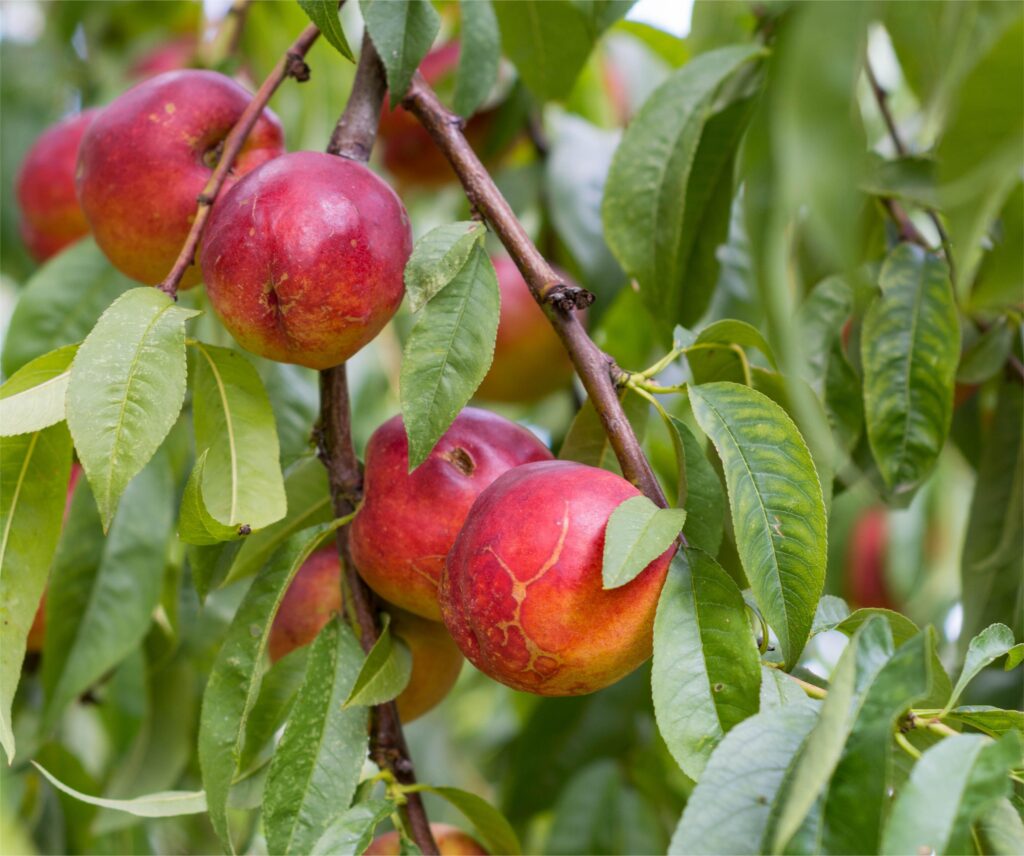
The method, developed by a research team at URV, analyses the biochemical changes in the leaves closest to the fruit without damaging it
How can you tell if fruit has reached its optimal ripeness without picking it, touching it or carrying out any test that might damage it? A research team from the Department of Analytical Chemistry and Organic Chemistry at the Universitat Rovira i Virgili (URV) has found the answer by applying near- and mid-infrared spectroscopy to the leaves closest to the fruit. They discovered that the technique allows reliable information to be obtained about the fruit’s developmental state without damaging it.
The study addresses a common challenge in the fruit sector: traditional techniques for assessing fruit quality – such as measuring firmness, sugar content or acidity – require collecting and analysing samples, which means a portion of the crop is destroyed and cannot be sold. Furthermore, spectroscopic techniques applied directly to the fruit can leave marks on its skin. This research team’s proposal focuses a little further away from the fruit by analysing instead the nearby leaves; this enables them to determine the physiological changes that occur as the fruit ripens without having to touch it.
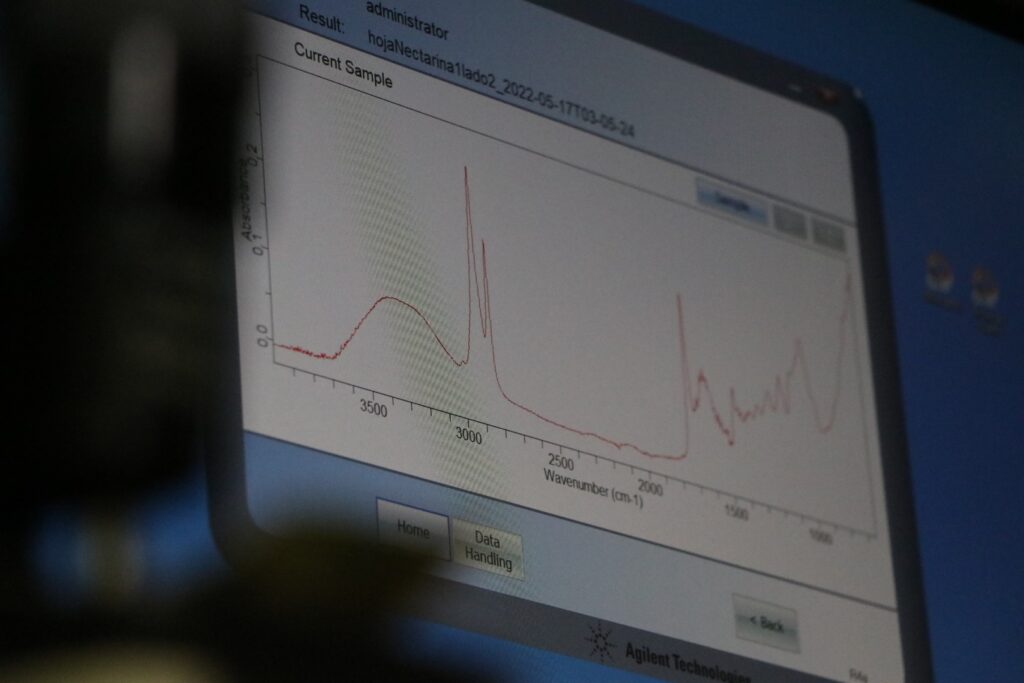
The technique that they used in their research, near- and mid-infrared spectroscopy, directs a beam of light at a sample (in this case, the leaves) and, from the light that is absorbed or reflected, information is obtained about its composition without altering or destroying the sample. “The leaves undergo physiological and biochemical changes as the fruit ripens, due to the direct connection between the metabolism of the leaves and that of the fruit. And these changes are reflected in their spectral fingerprint,” explains Daniel Schorn, a researcher in the ChemoSens research group at URV who took part in this study. By applying this technique weekly to the leaves closest to the fruit, the research team has managed to “read” the fruit’s developmental state without touching it.
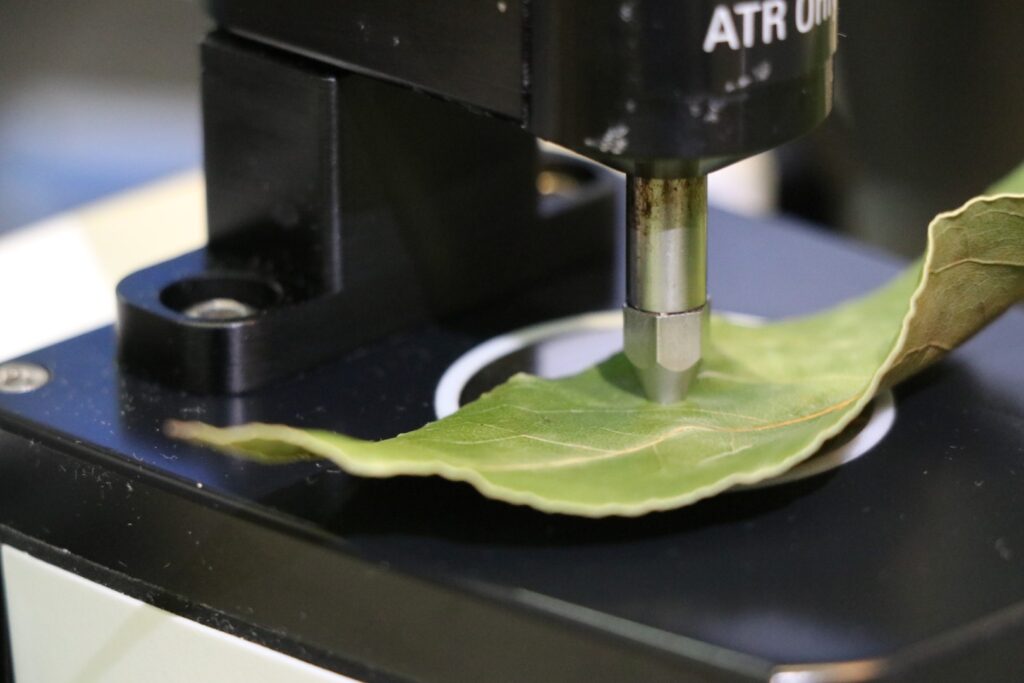
The study was carried out on a commercial orchard in Artesa, Lleida, where the ripening of the fruit on twelve nectarine trees was monitored over eleven weeks. During this time, samples were taken from both the upper and lower surfaces of the leaves, and factors such as orientation, height and position relative to the trunk were recorded. Statistical analyses showed that the factor with the greatest influence on the leaf spectra is time, that is, the progression of ripening. The results also indicate that combining spectral data from both sides of the leaf yields more accurate predictive models, as each side presents different characteristics in terms of composition and environmental response.
According to the research team, this system could transform the way that crops are monitored for their optimal harvest point, as it facilitates real-time decision-making and can contribute to the modernisation of precision agriculture. Furthermore, the technique can be directly applied in the field without the need to destroy any fruit. Although the models still need to be refined, particularly to improve estimations properties such as acidity, the researchers highlight the technique’s enormous potential to save time and produce, and to increase the quality of fruit available on the market.
“The main advantage is that we can anticipate the fruit’s development without damaging it and without needing to use complex tools. Analysing the leaves is faster, cleaner and compatible with field monitoring,” explains Schorn. This also allows producers to identify which trees or branches have fruit at the optimal point of consumption and to programme harvests for different days, selecting only those nectarines that have already reached the desired stage of ripeness and leaving the rest on the tree until they are ready.
Using leaves to determine the ripeness of fruit condition paves the way for the optimisation of crop management with adjustable harvests and reduced reliance on destructive sampling.
Reference :Spectroscopic Analysis of Proximal Leaves as a Method for Studying Nectarine Ripening. Jokin Ezenarro, Daniel Schorn-García, Ángel García-Pizarro, Montserrat Mestres, Laura Aceña, Olga Busto, and Ricard Boqué. ACS Agricultural Science & Technology Article ASAP. DOI: 10.1021/acsagscitech.4c00760
