Press notes 17/06/2026
URV applies a method to classify museum bones by age
The technique combines near-infrared (NIR) spectroscopy and chemometric tools to differentiate historic and modern specimens samples of red squirrel skulls and mandibles without damaging the specimens
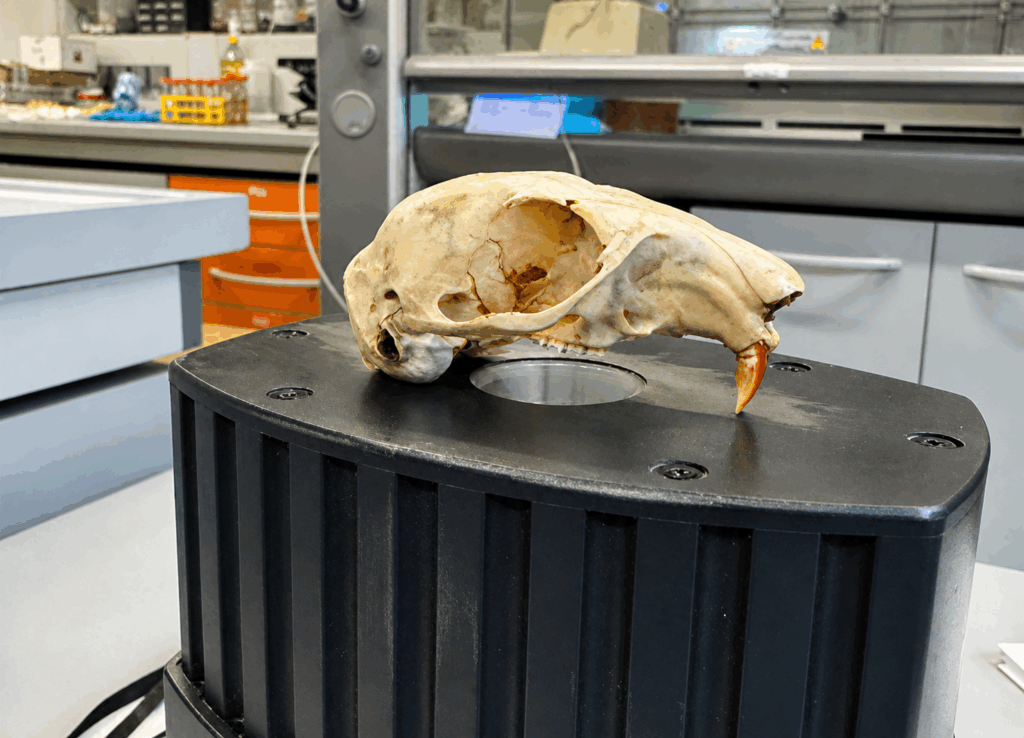
The technique combines near-infrared (NIR) spectroscopy and chemometric tools to differentiate historic and modern specimens samples of red squirrel skulls and mandibles without damaging the specimens
A study led by the Universitat Rovira i Virgili (URV), the Natural Science Museum of Barcelona, and the Università degli Studi dell’Insubria (Como, Italy) has successfully applied a method to classify bone specimens according to their age. Non-invasive near-infrared (NIR) spectroscopy was used to analyse red squirrel skulls and mandibles without damaging the bones. This in turn has led to the development of a classification model to help distinguish between old and modern specimens.The results have been published in the journal Analytical Chemistry.
It is estimated that there are 120 million specimens in natural history collections worldwide that cannot be used for research because their collection date is unknown. This in turn led the URV researchers to develop a technique to address this issue. To determine the age of the analyzed bones, it is first necessary to have reference specimens of known age that can be used for comparison and to establish a classification system for validating the methodology.
First, they obtained specimens with a known age; these specimens were then used as a point of reference to make comparisons and establish a classification tool. Once the reference samples had been defined, the researchers took the pieces to be studied and applied infrared light which, when it interacted with the bones, provided a spectrum showing which light wavelengths had been absorbed by the pieces and which had not. The research group led by Barbara Giussani, from the Department of Science and High Technology at the Università degli Studi dell’Insubria, carried out these NIR spectroscopic measurements. “One of the main innovations is that we also applied a chemometric method that allowed us to determine which parts of this spectrum may have had a higher error, thereby identifying the most reliable ones,” explained Jordi Riu, a researcher in the Research Group on Chemometrics and Sensory for Analytical Solutions (Chemosens) at the URV’s Department of Analytical Chemistry and Organic Chemistry.

Over the course of the study, the researchers analysed 59 bone specimens of red squirrel (Sciurus vulgaris) from the Natural History Museum of Barcelona. This species was chosen because a sufficient number of specimens were available. The researchers divided the specimens into two groups; namely, historical specimens collected between 1916 and 1923, and modern specimens, collected between 2005 and 2021. When they analysed the squirrel skulls, they were able to distinguish between historical and contemporary samples with 100% classification accuracy, whereas for the mandibles the percentage was slightly lower, between 87% and 95%. They obtained these results by using chemometric data processing, which is the branch of analytical chemistry that applies statistical methods to extract relevant information from data.
The non-invasive NIR spectroscopy technique detects changes in collagen and bone moisture. This is relevant because pieces classified as historical tend to be more porous due to degradation and thus to retain more ambient moisture, two factors that are readily revealed by infrared light. In addition to being non-invasive, the technique is notable for its speed insofar as it carries out the analyses in under a minute. “The bone is exposed to infrared light to obtain its spectrum,” explains Riu, ” you can then compare this with samples of known ages and draw conclusions”. This is a significant improvement over the old technique, which required part of the bone to be removed for X-ray analysis and which therefore caused damage to the sample. “Partial destruction of the sample was particularly problematic when dealing with very small species, such as a shrew or a hummingbird, with high scientific or heritage value,” explains Javier Quesada from the Natural Science Museum of Barcelona, who participated in the research together with Marc Campeny.
These results open up new possibilities for museums and laboratories, who will be able to apply near-infrared spectroscopy to other animals, such as birds, to identify species and to determine the origin of bones for which information is lacking. To achieve this, however, a sufficiently large number of reference samples is required in order to determine which bird or animal corresponds to each specimen.
Bibliographic reference: Riu, J., Giussani, B., Monti, M., Baruffaldi, L., Campeny, M., Quesada, J. (2026). Shedding Light on the Past: Temporal Classification of Zoological Specimens from Museum Collections with Portable NIR Sensors and Multivariate Error Modeling, 98 (13) https://doi.org/10.1021/acs.analchem.5c06767
