27/05/2025
Award for a URV research project that proposes a new method for designing roofs for large stadiums
The International Association for Shell and Spatial Structures has awarded the Tsuboi prize to the project, whose method can be used to design non-circular structures to cover large open constructions.

The International Association for Shell and Spatial Structures has awarded the Tsuboi prize to the project, whose method can be used to design non-circular structures to cover large open constructions.
Researchers at the URV have developed a calculation method for designing non-circular roofs for stadiums and other large-scale structures. The research provides an answer to the problem of designing non-circular bicycle wheel-type roofs, supported by means of in-plane triangulated radii. The innovative spirit of the article and the complexity of the mathematical challenge they have solved have earnt them the Tsuboi prize of the International Association for Shell and Spatial Structures (IASS). The authors of the research, Rodrigo Martín and Blas Herrera, although aware of the importance of the project, were taken by surprise by the award: “We didn’t expect to win anything; we research and publish because that’s what we do at the university”.
Engineers and architects face many challenges when designing and constructing large venues such as sports stadiums and exhibition centres. In the case of covered venues, one of the most important is the design of the roof. The need to create open spaces, without elements that obstruct the view or movement, means that architects have to leave a great distance between structural supports, and this in turn conditions all other aspects of the project, such as its aesthetic appearance, materials, construction process, etc.
Wheel-type roofs are one of the solutions that can be used. They are made up of two rings, one on the outside and one on the inside, joined by cables arranged just like the spokes of a bicycle wheel. When these spokes are tensioned, they pull the outer ring towards the centre and the inner ring towards the outside, thus supporting the whole structure. This is why the rings are also called the compression ring and traction ring, respectively. The resulting roofs are lightweight structures that require very little material compared to other more conventional designs.
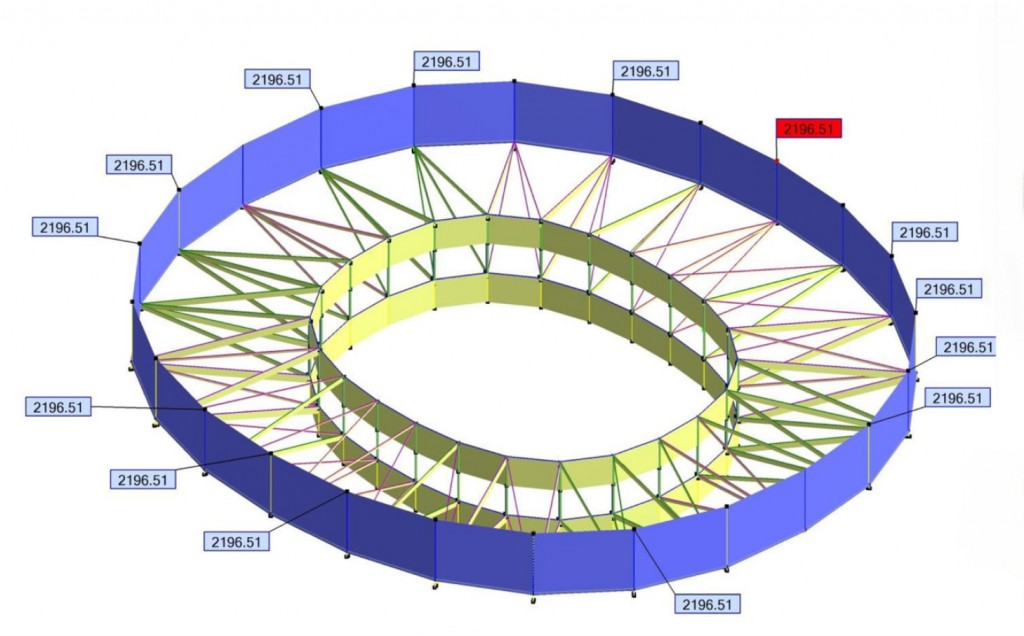
However, they also have drawbacks. Assembling them is a complex and delicate process, as the structure is not stable until it is fully tensioned and mounted. They are also very difficult structures to design because their shape is defined by the distribution of the stress forces of the spokes, which can be very intricate in non-circular structures, which is the case of most roofs. In order to address these weaknesses, the URV researchers set out to design a new type of non-circular roof based on the in-plane triangulation of its spokes.
When the spokes are triangulated in-plane, that is, set out in a triangular shape when viewed from above, they offer greater stability during assembly, but they also require a very complex mathematical problem to be solved: the shape of the roof depends directly on the tension of each spoke, and must be determined with great precision. Since none of the known procedures for solving similar systems could be applied in this case, the researchers had to program their own. They came up with an iterative mathematical method that starts from an initial, approximate solution and modifies hundreds of variables until the perfect version is found.
For the researchers, one of the most complicated challenges was to find the starting point of the design, the initial solution from which to begin the process. This first approximation includes the initial values of the variables that influence the shape of the structure, namely the angles, forces, positions, etc. “We didn’t know if our approach was valid until we found a way to define a sufficiently good starting point so that the iterative method could then find a solution to the design”, recalls Rodrigo Martín, professor of structures at the School of Architecture.

Internationally recognised research
Thanks to their research, non-circular wheel-type shells with triangulated spokes are now easier to design: “From now on, any engineer or architect, using our calculation method, can design a structure like this more easily”, said Blas Herrera, researcher at the Department of Computer Engineering and Mathematics. Due to the innovative spirit of the research and the complexity of the mathematical challenge they have solved, the International Association for Shell and Spatial Structures (IASS) has awarded them the Tsuboi prize, a very prestigious award, which is given to the best scientific article of the year published in the Journal of the IASS in the field of architecture and structural design.
The researchers confess, however, that the award has taken them by surprise: “The research was carried out with very few resources, in a very understated manner. We were just doing science, which is what we are here for; we never imagined that they would give us this award, it was a total surprise”. In the world of engineering, when a revolutionary solution is found, it is not usually shared, but kept in order to gain a competitive edge in a particular sector. In this regard this article is like the research carried out in all universities insofar as it reflects a desire to do science for science’s sake, with transparency. “All the mathematical, physical, structural work is in the article; perhaps that is why we have been awarded the prize”, said the authors.
Reference: Martín-Sáiz, R., & Herrera, B. (2024). In-Plane Design of Non-Circular Triangulated Tensile Spoke Wheels. Journal of the International Association for Shell and Spatial Structures, 65(3), 189–205. https://doi.org/10.20898/j.iass.2024.005
