15/10/2025
The URV brings together experts from around the world on statistical data confidentiality
Researchers from the Department of Computer Engineering and Mathematics are organizing the Meeting of Experts on the Confidentiality of Statistical Data, a biennial event of the United Nations Economic Commission for Europe (UNECE).
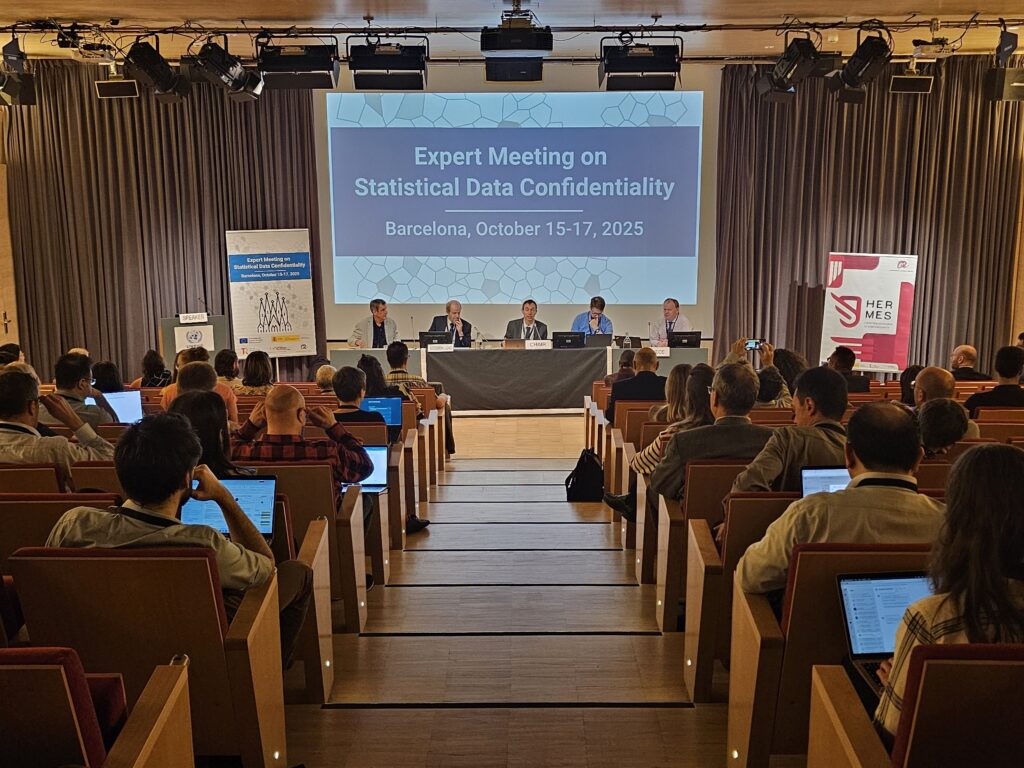
Researchers from the Department of Computer Engineering and Mathematics are organizing the Meeting of Experts on the Confidentiality of Statistical Data, a biennial event of the United Nations Economic Commission for Europe (UNECE).
The potential of open data and artificial intelligence tools to improve citizens’ quality of life is undeniable. However, as Professor Josep Domingo-Ferrer of URV points out, these technologies also raise challenges that must be addressed to ensure a pluralistic, fair, and democratic society. For AI models to function as they do, they must be fed with massive amounts of data. Once these intelligences have recorded certain information, it is very difficult to make them forget it; for now, it cannot be guaranteed that they do so with complete security. This phenomenon is particularly relevant when the data are personal or private in nature, such as those contained in statistical reports issued by official bodies.
To address issues like this, the Universitat Rovira i Virgili has organized the Expert Meeting on the Statistical Data Confidentiality, a biennial event of the United Nations Economic Commission for Europe (UNECE). This year’s edition, held in Barcelona starting this Wednesday for two days, focuses on the challenges that big data and artificial intelligence pose to public administrations, whose duty is to protect citizens’ data privacy rights. This forum, which brings together experts from European, North American, and Asian institutions, also provides a platform for knowledge exchange and collaboration.
The organizing committee, made up of Professor Josep Domingo-Ferrer, several experts from national statistics offices and universities, as well as UNECE staff has put together an intensive program of specialized presentations and debates. It is structured around twelve key topics for the protection of official statistical data, ranging from how to anonymize the publication of microdata — very specific data providing direct information about people or their behavior — to finding the right balance between the risks of data disclosure and the information loss that comes with protecting them.
In this regard, some sessions will focus on how AI models can be both a tool and a threat to the confidentiality of statistical data and how they can enable the leakage of personal information. The program also includes discussions on ensuring the security of data releases — such as statistical tables and maps — by addressing traditional techniques and innovative methods. Real-world experiences and case studies will also be shared, showcasing the use of advanced techniques to protect large sets of census data.
“This consolidates the URV’s CRISES group as a reference in statistical confidentiality in Europe. The group has been dedicated to this field for many years and is very active in facilitating opportunities for the community to meet and discuss,” explains Domingo-Ferrer. The UNECE Expert Meeting on Statistical Data Confidentiality, whose hosting was supported by the European Union through NextGeneration funds — via the INCIBE-URV Cybersecurity Chair — will conclude on Friday with sessions devoted to debating and formulating proposals for the future of research in this area. The aim of this final day is for the exchange of experiences and professional collaboration fostered during the previous two days to materialize into a working agenda for improving the confidentiality of statistical data.
About the HERMES Project
The goal of the HERMES project is to carry out high-level research in specific areas of cybersecurity, promoting the valorization and transfer of results to society and productive sectors. It encompasses two initiatives: the HERMES Strategic Project and the INCIBE-URV Cybersecurity Chair, both funded by the European Union (NextGeneration) through the National Cybersecurity Institute (INCIBE).
These initiatives are carried out within the framework of Spain’s Recovery, Transformation, and Resilience Plan, the government project that outlines the roadmap for modernizing the Spanish economy, recovering economic growth, and creating jobs for a solid, inclusive, and resilient economy capable of meeting the challenges of the next decade.
