The URV Industrial Doctorates programme offers students the chance to prepare their thesis while working at a company, allowing them to gain experience in a real working environment and acquire highly valued skills, while at the same time helping to boost the competitiveness of the business sector and the technological and social progress of the region
Ivan Hortigüela has always wanted to ensure that his academic work is not confined to a computer screen, but rather that it also has a social impact. When he completed the thesis for his Bachelor’s Degree in Law, for which he studied civil liability arising from environmental crimes, he did so as part of the Service-Learning Programme, where his project benefited a non-profit organisation, the Ter Defence Group. The whole experience confirmed to him that environmental law was the field he wanted to continue his training in so that he could pursue it professionally. This is why he then went on to do the Master’s in Environmental Law at the URV, during which he continued to apply the research from his undergraduate dissertation, especially within the framework of the Environmental Legal Clinic module, which also had a strong social outreach component. And now that he is doing his doctorate, he is continuing to seek, as he puts it, “to develop knowledge and tools through research that will be beneficial to the business fabric of Catalonia”.
The programme is not limited to ‘traditional industrial’ areas, such as the sciences and engineering, but also includes fields such as health, social sciences, arts and humanities
All of this is because Hortigüela is studying for his thesis within the URV’s Industrial Doctorates programme. It is a strategy implemented by the Catalan Government through its University Research Grants Management Agency (AGAUR) in collaboration with public and private universities, and it aims to promote the competitiveness and internationalisation of the country’s businesses, retain talent and prepare doctoral students so that they can carry out in-company R+D+I projects. In other words, they conduct their research for their thesis while working at a company. The company benefits by being able to expand its business lines thanks to the advances made by the student, who, in turn, has an intensive learning experience that combines being in a real work environment and studying for the training courses that they are required to complete for their doctoral degree.
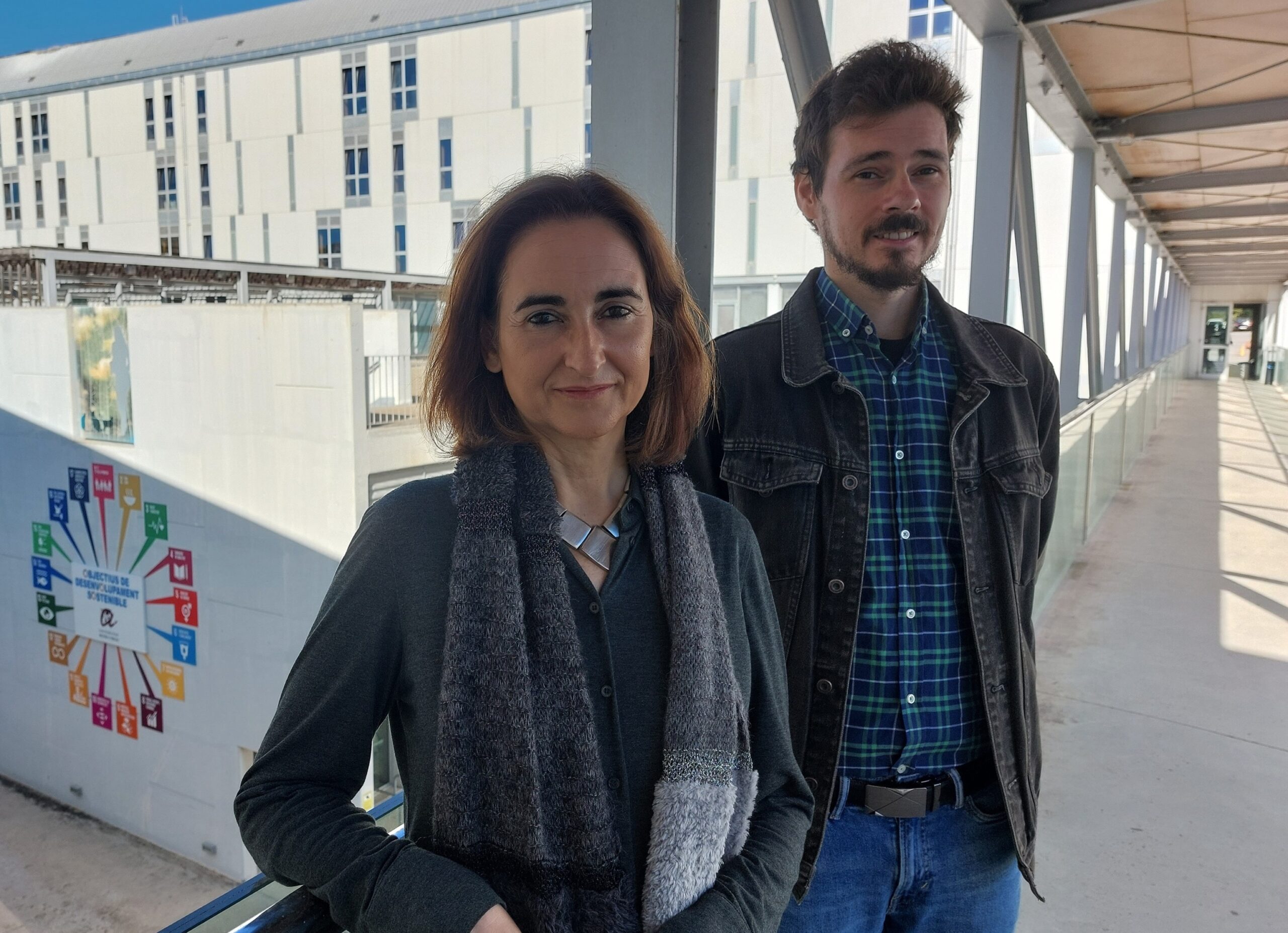
In Ivan’s case, the subject of his research is the illegal trafficking of plastic waste, specifically the development of legal tools to prevent it from occurring. He is conducting this research while working for the company Insta, a Tarragona-based legal consultancy specialising in environmental law. In fact, Hortigüela had already started working at Insta after completing his master’s degree thesis on the same topic, and the opportunity to do an industrial doctorate came up once he was at the company, as Maria Marquès, a professor in the Department of Public Law and his thesis supervisor, explains. In fact, she supervised his undergraduate and master’s theses. “He had always expressed a desire to continue his training, even though he was already working at a company. In the department, we are very aware of the Industrial Doctorates programme because we attended a specific course on how to promote such doctorates in the field of law, and we are always looking for opportunities. We could see that Ivan’s case fitted perfectly and we spoke to the company’s manager to explore the possibility of creating this industrial doctorate position.” The overall programme is actually run by the Catalan Government, so anyone can apply.
Although there were other candidates, Hortigüela won the post. So, while he remained at the same company, he could now focus exclusively on his research. Maria Marquès points out that companies in other technological sectors have research and innovation departments, but this is not the case the field of law, where research is more informal and focused on preparing specific cases. “The Industrial Doctorates programme enables law companies to dedicate time and resources to generating knowledge in a much more in-depth way so that they then have tools which they can apply,” says Marquès.
Thirteen years of industrial doctorates
The URV participated in the Catalan government’s pilot scheme for industrial doctorate grants in 2012. Since then, 44 students have completed an industrial doctoral degree course, 33 of whom have successfully defended their theses. Currently, 37 doctoral students, from all knowledge areas, are undertaking an industrial doctorate at the URV with active funding from AGAUR. There have also been eleven students who have studied for industrial doctorates in European projects outside the Catalan government programme.
Ivan’s story started five years ago, however, and he has finally reached the last stage of the process. He has already submitted his doctoral thesis and now only has his thesis defence to go, which he will be doing shortly. “It has been a long process because it is a complex subject and new developments keep emerging all the time, but this has meant that the final product is innovative and up-to-date. It is very satisfying to see all of my efforts finally come to fruition,” says Hortigüela, who attaches great value to the in-company research opportunity that he has been given, especially because it has enabled him to learn about “the day-to-day business of a legal consultancy specialising in environmental law and its application in the service of citizens and the environment.”
Maria Marquès, who has closely followed much of Ivan’s academic journey, highlights his strong intellectual development over these years, the cross-disciplinary training he received during the industrial doctorate, which includes courses on entrepreneurship and project development, and, ultimately, the tools that he has gained for use in the world of work. But for her too, and therefore for the department and the University itself, it has also been an enriching experience, as supervising the thesis has given her “the opportunity to see what the most important issues in environmental law currently are and how they are being addressed”. She also points out that University has had no need to ensure that Ivan’s studies had a real social impact because this is an inherent characteristic of the industrial doctorate programme. “From the outset, the doctoral candidate is providing real answers to real challenges,” she says.
Practicality
Anna Mas’s case is different from Ivan’s. A chemical engineer from the UPC and specialising in chemical processes, she saw an advertisement while looking for a job that caught her eye. Greenova, a foundation that develops projects to combat global warming, was offering a position in a specific project to create a device to capture carbon dioxide from the air. She was particularly taken with the practical application of the project and decided to apply. She later learned that, in addition, the post was actually a scholarship linked to an industrial doctorate at URV. In fact, she had never seriously considered doing a doctoral degree, but all of a sudden she was presented with the perfect opportunity, so she took the plunge. She passed the selection process and thus embarked on an enriching four-year experience, which she brought to a close last May after successfully defending her thesis.
An award-winning industrial doctorate project
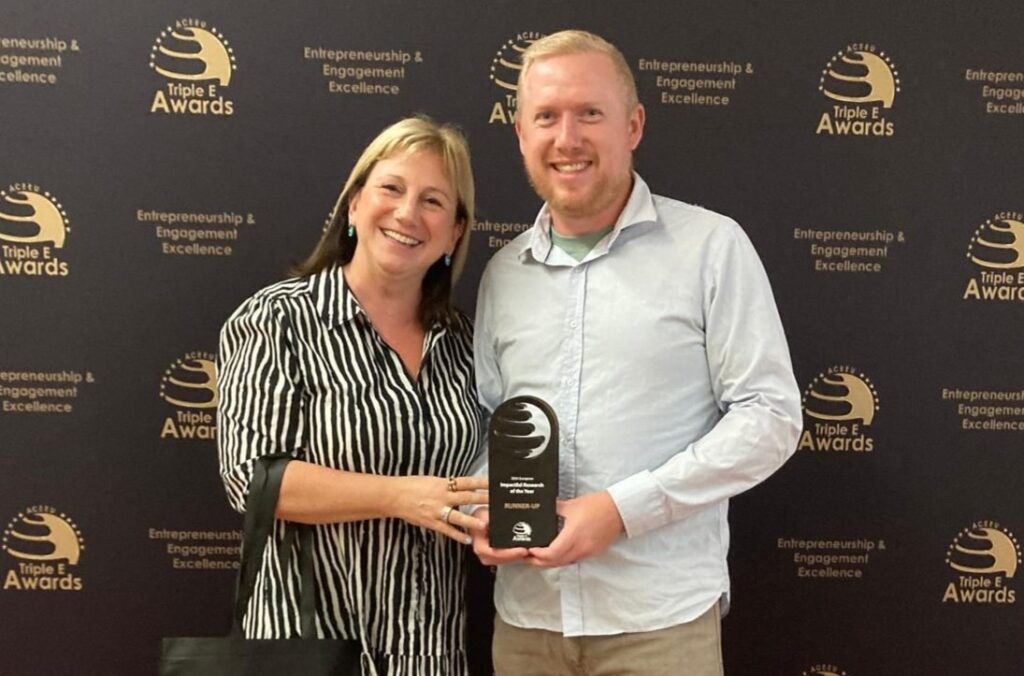
Jonathan Pidgeon-Hancock is undertaking an industrial doctorate with the Onada Foundation, which works to improve the quality of life of people with physical disabilities or mental health disorders. His research focuses on designing an English test adapted for the foundation’s users, which will lead to the first official examination for people with special educational needs, who until now have lacked language assessment tools. He is developing the project whilst working at the foundation, and he is being supervised by Mar Gutiérrez, professor at the URV’s Department of English and German Studies (pictured alongside Pidgeon-Hancock), and Yolanda Roure, head of the Onada Foundation. The project has won the Impactful Research of the Year award in the prestigious Triple E Awards.
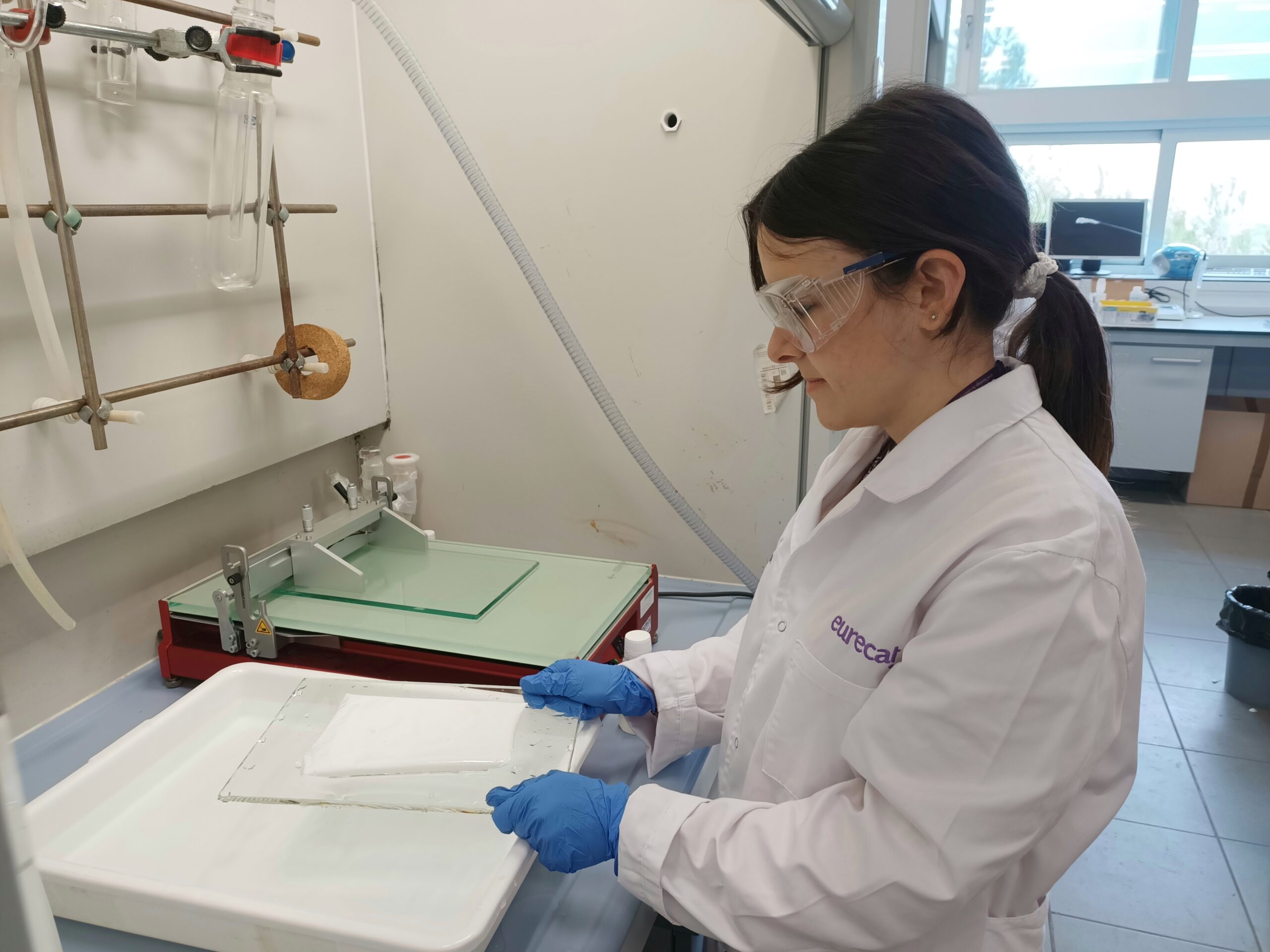
“The best part has been working on a collaborative project involving Greenova, Eurecat (where I physically worked), and the MEMTEC (Materials Membrane and Encapsulation Technology) research group, of which I was a member. Everyone has contributed their expertise: the URV, its knowledge; Eurecat, its capacity for transfer, and Greenova, its ability to commercialise the project’s outcome,” explains Anna, pleased to have been able to “apply the research results in real-life situations” and to have seen how the entire process works from different perspectives.
Anna Mas, who had Ricard Garcia Valls as her thesis supervisor at the URV, considers it “a privilege” to have been able to do her doctorate while working for a company, with better working conditions than most doctoral candidates and with the constant motivation of watching her research being applied. For the company, it is very productive having an employee like Anna, who is newly qualified, possesses up-to-date knowledge and is fully focused on a project through her thesis. Anna’s time at the company was capped off when the instrument that she developed was given a patent in preparation for its commercialisation. When the time comes, the company is likely to contact her again, but for now she is focusing on finding another motivating project, which should not be difficult for her to find thanks to the academic and professional CV she has built up in a short space of time. She hopes that companies will continue to seek out and value the expertise that someone with a profile like hers can offer in order to continue contributing to the decarbonisation sector, which is becoming increasingly important in the industrial landscape.
Eudald Tuxans still has some way to go in his doctoral thesis process. Like Ivan Hortigüela, he was already working at a company when he was offered the opportunity to begin an industrial doctorate. A graduate in Biological Systems and holder of a Master’s Degree in Environmental Engineering from the UPC, he joined the company in May 2023 as an R&D engineer in the innovation department, primarily developing prototypes of things that had previously been worked on and validated in the laboratory. He was mainly focused on two projects in collaboration with the URV’s AMIC (Environmental and Industrial Applications of Catalysis) research group: the VAL2H2, which aims to develop technologies to convert organic waste, mainly from tree management, into bioethanol and hydrogen, and Despoliplast, which develops technologies to produce additive fuels from plastic waste, thus giving them a second life. “I wasn’t planning on doing a doctoral degree, not even an industrial one, but between the three of us, that is, the company, the University and myself, we saw that the pieces fitted together and that we could all benefit from the opportunity offered by this type of programme,” explains Eudald.
So, after winning the position created by the Catalan government, he started to work as an industrial doctoral student; that is, he carried on doing the same work as before but was now able to supplement it with doctoral studies: “In the end, the work I do now hasn’t changed much from what I was doing before. That said, I’m fully focused on these two projects, which form the basis of my research, and I’m doing training in project management, entrepreneurship, patents… which will stand me in good stead for my future career.”
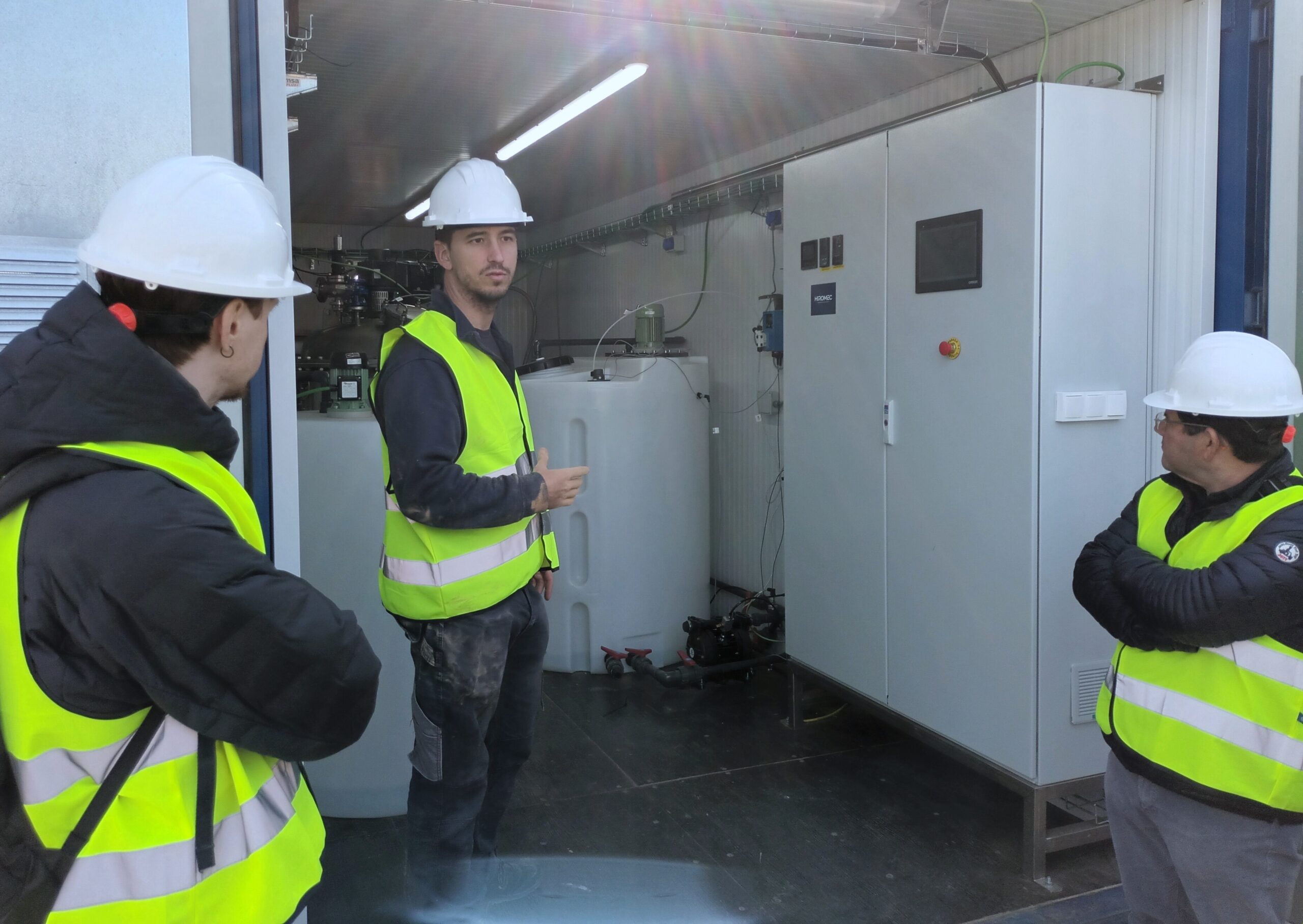
Francesc Medina, a researcher in the AMIC group at URV, is Eudald’s thesis supervisor, and Teresa de la Torre, Head of R&D in the Innovation Department, supervises him at the company Sorigué. All industrial doctoral students have a thesis supervisor at the URV and a tutor at the company, both of whom monitor the student’s work and report on their research progress. Teresa de la Torre explains that Sorigué, and she herself at a previous company, have had industrial doctoral students on other occasions. “It is very beneficial because we have an employee with a very strong commitment to their work who, in addition, is being trained while they work, which adds value to their position,” explains De la Torre.
For now, Eudald still has a couple more years to go – the scholarship funding will run until 2027 – and he is aware that he will soon have to start putting his research into writing. But for the time being, he is very happy with the balance between his work and his studies and with benefits that this is bringing to is professional development.
A model of success
These cases demonstrate that the Industrial Doctorates programme, in the words of María Ángel Lanuza, Director of the URV’s Doctoral School, is “a solid and useful model of success both for universities and the local business and social fabric”. She goes on to stress that “over the years, the programme has grown both in its number of projects and in the diversity of its sectors”, and points out that the programme is not limited to areas that are traditionally considered industrial, such as the sciences and engineering, but also includes fields such as health, the social sciences and the arts and humanities. Finally, she highlights that the URV’s industrial doctoral theses are largely produced at SMEs and that, therefore, they are not only beneficial to large companies.
Despite the programme’s consolidation, Lanuza assures that work continues to address ‘the emerging needs of companies and thus ensure economic and social strengthening through innovation’. According to her, industrial doctorates perfectly represent the knowledge transfer and innovation that are among the University’s core principles, especially because of the collaborative nature between the academic and business worlds. “Doctoral candidates acquire highly valued skills in the job market, combining research training with experience in real-world environments at companies or institutions,” she states. Above all, as all those involved agree, the programme has a direct impact on business competitiveness and on the technological and social development of the region.