The URV, through its the interdisciplinary ARGET research group, seeks to harness technological advances and digital tools to enhance teaching
Since its creation, the ARGET research group at the Universitat Rovira i Virgili has specialised in education and technology and in keeping up to date with the technological innovations that can improve and support teaching and learning processes. The researchers’ aim is to find ways of applying these innovations, but only once they have been scientifically proven to be appropriate and beneficial. It is therefore not surprising that these same researchers immediately went on the alert a decade ago when people first began talking about smart classrooms. One of the researchers, Ramon Palau, from the URV’s Department of Pedagogy, realised at the time that everyone was defining the concept of intelligence in their own way and that there was no clear consensus on what a smart classroom should look like.
“We were clear that data collection and decision-making were the key to improving teaching,” says Palau, who points out that these concepts were mainly applied in virtual environments and that the researchers were convinced they could be transferred to physical spaces with the aim of improving teaching-learning processes, which are characterised by continuous interactions and dynamics between teacher and student to facilitate the acquisition of knowledge, skills and competences in an autonomous and meaningful way.
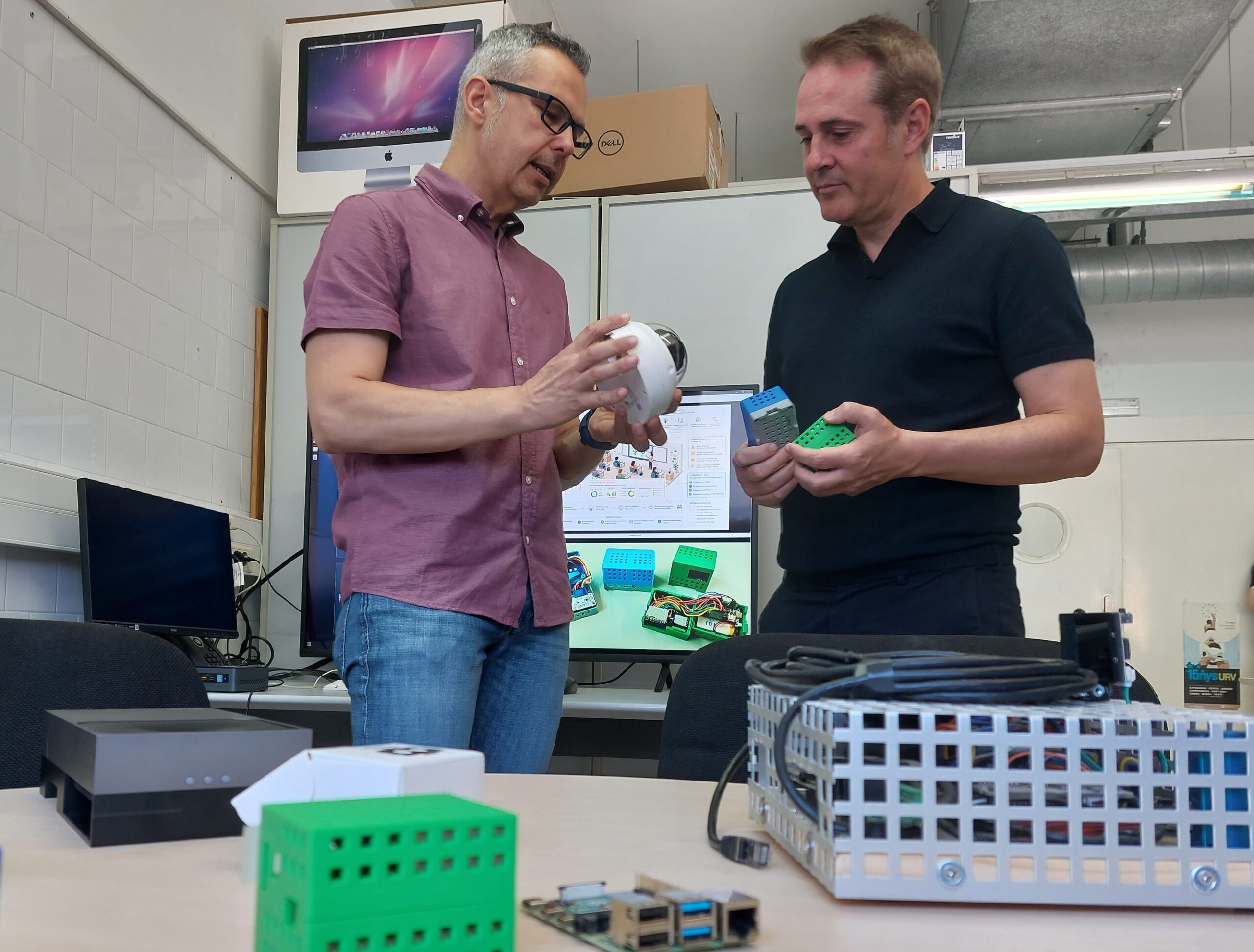
The idea began to evolve under the continued efforts of the ARGET researchers, until it was indirectly accelerated by the coronavirus pandemic. They collaborated on the Actua project, funded by the Catalan government, which developed a sensor kit to determine the extent to which the classroom environment, air quality, noise, temperature, ventilation and so on could help the spread of viruses. “We found that smart classrooms could be implemented as a contextual environment, that is to say, as the sum of environmental and physical elements and of the state of the teacher and the pupils too. They could ultimately provide us with data that gives us a great deal of information about the conditions in which a lesson is carried out,” explains Ramon Palau.
The Smart Classroom project by the Department of Pedagogy and Computer Engineering collects environmental data and the status of the teacher and students so that the teacher can make better decisions to prepare and carry out lessons
The ARGET research group developed the cross-cutting and multidisciplinary Actua project, which involved participants from across various disciplines, namely mechanical engineering, pedagogy, chemistry and computer science. ARGET got in touch with another research group, Smart Technologies, from the URV’s Department of Computer Engineering and Mathematics (DEIM), and asked them to provide the kits for Actua’s IT infrastructure. The groups then realised they could complement each other and that their objectives could be aligned.
ARGET had been accumulating expertise on the impact of environmental conditions on teaching, and Smart Technologies was able to provide the technology to measure them. As one of its researchers, Toni Martínez Ballesté from the DEIM, explains: “What we came up with was a system with monitoring units, such as noise or air quality sensors, and a wristband that allows the wearer’s heart rate to be recorded in real time. With all these sensors, we have what we call data collectors, which send the most significant changes to the central server. There they are stored in a database in accordance with a structured ontological model of all the knowledge and all the data generated within the smart classroom.” This entire system, with its real-time data, generates a technological assistant that the teacher can consult.
The incorporation of AI tools
One of the lines of research that Judith Balanyà and Janaina Minelli, researchers in the Department of Pedagogy, have followed in recent years concerns the pedagogical use of digital technologies, such as mobile devices, in the classroom. This research has evolved towards the incorporation of artificial intelligence tools into teaching, especially through educational chatbotsintegrated into virtual classrooms. This is the case with their current teaching innovation project, “Virtual Dialogues for Autonomous and Personalised Learning”, a proposal that is already being applied in undergraduate and postgraduate courses across different disciplines. “The idea is not to replace teacher-student interaction, but to broaden the possibilities for supporting students by allowing them to consult materials, receive guidance, answer their own questions, practise content and progress more autonomously, but always within a pedagogical framework designed and supervised by the teaching staff,” they state.
Mention should also be made of the AI Skills Lab project, led by Mar Camacho, a researcher in the Department of Pedagogy. Thanks to this project, nearly 300 teachers from eleven educational centres in the region have acquired advanced digital skills in AI. Camacho is also behind the project “[A]Intelligenz: Artificial Intelligence in Education – Acquisition of Advanced Digital Competences for Pupils and Teachers in Primary and Secondary Education centres”.
“Nowadays we have devices with a great deal of computing power that can develop a kind of mini ChatGPT which, in addition to being able to interact with the different classroom monitoring units, are capable of extracting information and communicating it to the teacher,” explains Martínez Ballesté.
The objective, according to Ramon Palau, is “to take advantage of the fact that many things happen in a classroom, some of which are caused by the teacher and the students and others by environmental factors (temperature, humidity, noise, particles, etc.), and so the aim is to collect all this data and give it to the teacher so they can make better decisions when preparing or delivering their lessons.”
The data also include the students’ reactions, levels of fatigue or distraction, all collected by cameras placed in the classroom. It will of course be necessary to see whether the European Union’s regulation of AI systems affects them in any way, although they are convinced they will find solutions to adapt to it. “With more information, the teacher can decide, for example, whether to change the activity, make it shorter, or look for others that change the dynamic.”
As Palau goes on to explain, this whole system also helps to care for the teacher, who is the most important piece in this entire teaching and learning process: “There are more and more situations of teachers with stress, on sick leave with anxiety or suffering from burn-out. If we have more information about what is happening to them or about the environment, we can see which situations are the highest-risk, for example, certain times of the day, particular activities, high temperatures, etc. Thanks to this whole system we can make correlations, extract patterns and tell them what they can do to avoid stressful situations.”
All the technology that supports the smart classroom was tested during the Actua project, which was rolled out in around 150 classrooms, and the monitoring units are now being tested in the laboratory, “mainly to ensure they reconnect if the power fails, that they are robust…”, according to Toni Martínez Ballesté, who believes that the challenges ahead are to ensure privacy protection (in close collaboration with the legal sector) and IT security.
A different type of classroom
If multidisciplinary research and the publication of various articles underpin the work on smart classrooms by ARGET and Smart Technologies, then innovation is the foundation of the Ideas Classroom (Aula d’Idees), a space located at the URV’s Terres de l’Ebre Campus where different learning activities are mediated through the interactions between users and the use of ICT (Information and Communication Technologies). In this space, students on the Bachelor’s Degrees in Primary Education and Early Childhood Education can practise using the most innovative pedagogical tools, often with pupils from local schools, who both expand their knowledge and, at the same time, help the URV students to determine whether their teaching strategy, and the technology that supports it, is appropriate. The Ideas Classroom is designed with flexibility in mind so that, for example, the furniture can be arranged in different layouts and thus adapt the classroom to diverse working methodologies and ensure interdisciplinarity and cooperation within the framework of the teaching-learning process.
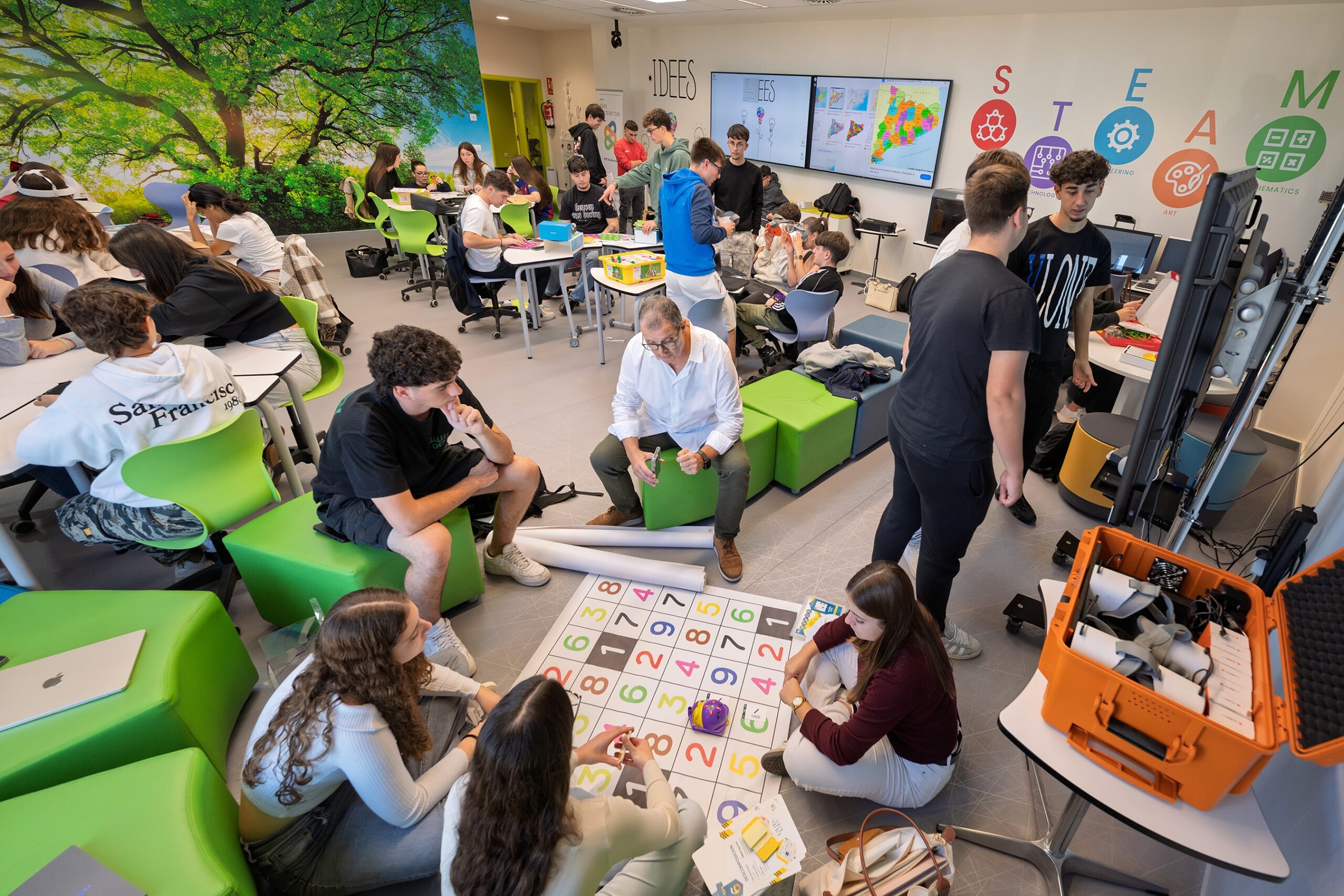
Josep Holgado, coordinator of the Bachelor’s Degree in Primary Education at the Terres de l’Ebre Campus and head of the Ideas Classroom, points out that, since its early years, the campus has had the Education and Technology Laboratory (ETLAB), where students can apply the knowledge they have acquired from their theoretical classes by putting it into practice with various pedagogical tools. The ETLAB equipment has been provided by its own internal funding, from projects it has participated in, and through agreements with pioneering IT companies that wanted to enter the education sector.
“These collaborations were born out of an idea to develop a distinctive classroom with cutting-edge furniture and technology that could help us in the work that we do. There are many smart classrooms, but what makes ours unique, apart from its distinctive furniture and capacity for 25 students, with spaces for designing, for thinking, for building and so on, is the presence of cameras that allow us to record the activities that take place there.” For example, when a school is invited to take part in activities designed by the campus students, those who cannot attend due to a lack of space can follow them synchronously.
The Ideas Classroom at the Terres de l’Ebre Campus features virtual reality tools, tablets and digital screens, robotics; that is, the latest technology to support teaching
Activities are also organised on a bespoke basis for schools if they are studying a particular subject and are interested in having URV students design pedagogical activities using the technology available in the Ideas Classroom. “The benefit that we get from this is the feedbackand constructive criticism we receive from the students and teachers at the schools,” says Holgado, who is also a member of ARGET.
The Ideas Classroom has, for example, virtual reality tools, tablets and digital screens, robotics, and so on, in other words, the latest technology to support teaching. “For example, we have a robot that can speak 150 languages, and can change its facial expressions and blink its eyes. It is very useful for those schools that have new students joining them throughout the school year, often from abroad and without the ability to speak Catalan or Spanish.”
All the material from the Ideas Classroom is made available to local schools because it enables them to access tools that they don’t have themselves. Consequently, the aim is for university students to know how to operate all of these tools before entering the profession. In return, thanks to a bilateral agreement with the Department of Education and Vocational Training, the schools now allow URV students to come into their classrooms to observe or teach classes as part of their practical training, for which they use tools from the Ideas Classroom.
The Ideas Classroom is always up to date with the latest technological innovations because, as Josep Holgado explains, they are always monitoring information that appears on the Catalan Educational Telematic Network and collaborating with the Permanent Resource Centres of the Territorial Services for Education and Vocational Training in the Ebro Delta. “This means that our students even become the first trainers in these tools,” says Holgado, who points out that working together with many companies in the technology sector is also key to staying up to date with the latest innovations, as they ask for advice and for them to test and verify the new tools developed.
Improving and guiding digital skills
Smart classrooms and the Ideas Classroom demonstrate the vast possibilities of technology in the field of education. But to what extent is it currently being used? Are teachers ready to integrate it into their classes? This is what the project seeks to find out, with a team of ARGET members led by researcher Mireia Usart from the Department of Pedagogy. They have long been assessing and helping to improve the digital competence of teaching staff and students through studies in which they describe the current state of play and from which they set out guidelines for the optimal use of technology. “Teachers’ digital competencies must include the capacity to accompany and support students to ensure that they use technology in a critical and ethical manner,” states Mireia Usart, who argues that the use of new tools should focus not on the quantity but rather the quality of their application.
Robotics and computational thinking
The Robots meet arts project, involving ARGET researchers Cristina Valls and Vanessa Esteve, sought to “revolutionise primary education by integrating robotics and programming into the arts and humanities curriculum”. More specifically, the partners in this European project set out to develop a platform to train teachers, gather content to apply in the classroom and expand scientific knowledge of computational thinking in the educational field. “We though it was a very attractive proposal, especially because it added an artistic dimension to a technological context, and also because it opened the door to working on inclusion in the classroom by designing activities with varying levels of difficulty,” state the researchers. Computational thinking helps children and young people to develop skills such as problem-solving, logical reasoning and creativity, as it is a style of thinking, inspired by the way computers work, that breaks problems down into smaller parts to find solutions.
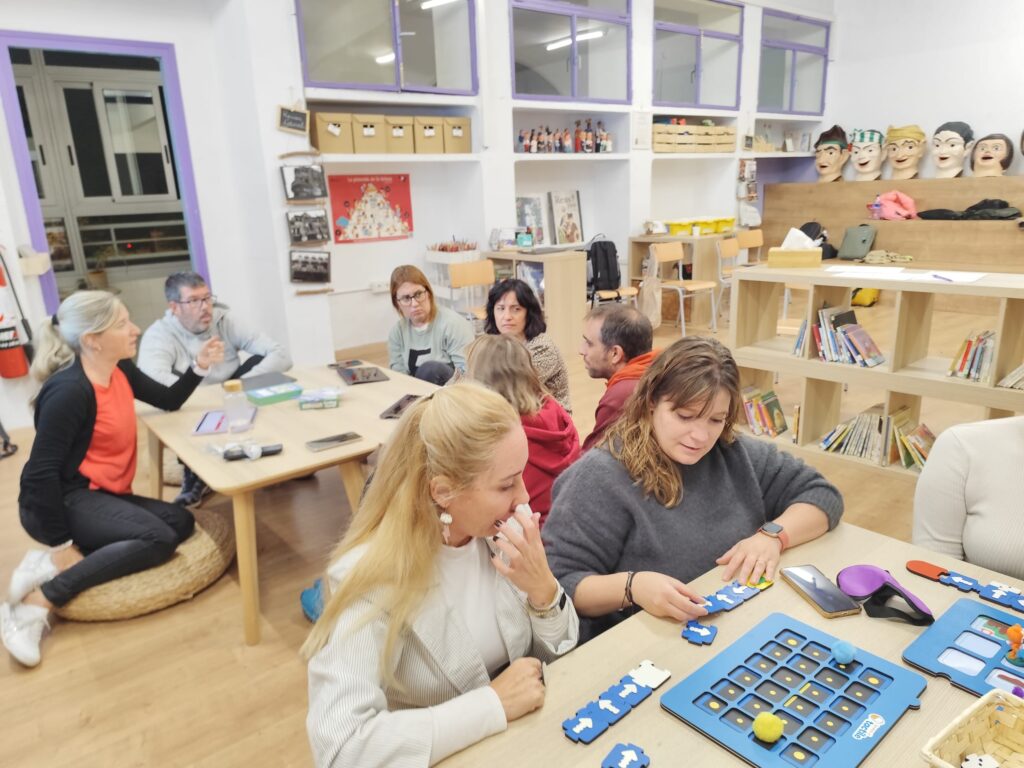
The project devised around forty proposals for introducing computational thinking into the classroom. Teachers can find unplugged activities, which do not require any technological devices to introduce computational thinking (like the ones in the picture, at a school in Reus); proposals that use physical robots, such as the Bee-bot, a robot capable of memorising a series of movements and executing them, and activities based on virtual programming environments like Scratch, a programming language that uses coloured blocks instead of code. Among the most notable examples are activities in which pupils have to design choreographies where the robots have to dance in a “mirror effect”, or in which they have to solve ethical dilemmas through programming.
The success of Robots meet arts has served as a catalyst for the launch of a new research initiative: the European Robotics Teachers’ Academy. This new project, involving most of the original partners, seeks to provide teachers with practical and accessible tools so that they can use educational robotics in a way that connects different disciplines and skills in early years and primary education, and to accredit the skills acquired through official EU qualifications such as micro-credentials.
According to some studies, Usart explains, teachers consider themselves digitally competent, but in reality, in the classroom, they tend to limit themselves to little more than a bit of gamification in the form of Kahoot activities, for example, which are easy to prepare and are widely accepted in class. Consequently, there has always been room for improvement in this area.
Currently, Mireia Usart is leading the project Sustainable Digital Ecosystems in Education (EDSSE), which concludes at the end of the year. It is an empirical research project that takes an inclusive, qualitative and interdisciplinary approach to improving the level of digital competence in both teachers and students by generating strategies and models for innovation using digital technologies. The aim is to generate new knowledge about teaching and learning processes by describing and understanding the processes involved in a sustainable educational digital ecosystem.
The researchers therefore asked which technology-enhanced teaching practices are most commonly used and which ones actually lead to better learning. They have interviewed more than 200 teachers from across Spain and at all educational levels, and have visited classrooms to see how the technology is used. “We are now analysing the responses and creating a model for a digital ecosystem that is sustainable, not only in terms of the environment and the Sustainable Development Goals (SDGs), but also over time. It is therefore crucial that teachers learn to use technology and adapt to change,” says Usart.
As the ARGET researcher explains, the study allows them to identify “what the best practices are, which variables make them so, what it means for a teacher to be digitally competent and what uses of technology can be made in the classroom for it to be truly useful”, for it to add something that analogue methods cannot offer.
For the moment, the study’s initial findings suggest that flexible classrooms, those that allow furniture to be moved and which contrast with more traditional classrooms of students’ desks facing the teacher’s desk, are the ones that favour a better integration of educational technology. These classrooms, for example, facilitate the use of tablets and laser printers and the introduction of augmented or virtual reality.
The study has also involved researchers from other fields of knowledge, such as Mariona Genís from the URV’s School of Architecture. In this regard, another of the conclusions is that light, ventilation and collaborative spaces encourage the educational use of digital technologies. Therefore, as the study’s findings indicate, the digital transformation of schools also involves the architecture and design of classrooms.
“The ultimate goal must be to redesign classrooms so that they are architecturally versatile and can adapt to all suitable configurations for introducing technology,” says Mireia Usart. Until that is possible, ARGET has another project underway, which also involves collaboration with Mariona Genís at the ETSA and with Toni Martínez Ballesté at the ETSE. In response to a call announced by the Institute of Education Sciences (ICE), they have conducted a teaching innovation project to develop a trolley built from recycled materials that can be used to move the technology and devices to, from and around the classroom. “Because of all the equipment that it carries, when the trolley comes into a classroom it completely transforms it. Furthermore, it has an integrated 360-degree camera that can film the interactions taking place during teaching-learning activities.”
The key is, therefore, collaborative, interdisciplinary work that uses technology to support and enhance the teaching and learning process. However, researchers remind us that we must always leave spaces that are free of technology, encourage computational thinking among students and devise activities that are equally communal, interactive and, crucially, disconnected from technology. Above all, technology should be a tool to help develop critical thinking, ideas and initiative.