





The total solar eclipse of 12 August 2026 will be a once in a lifetime event, and the URV has turned it into a scientific outreach opportunity by organising events that explore the phenomenon in a way that cuts across disciplines and highlights different ways of understanding the world
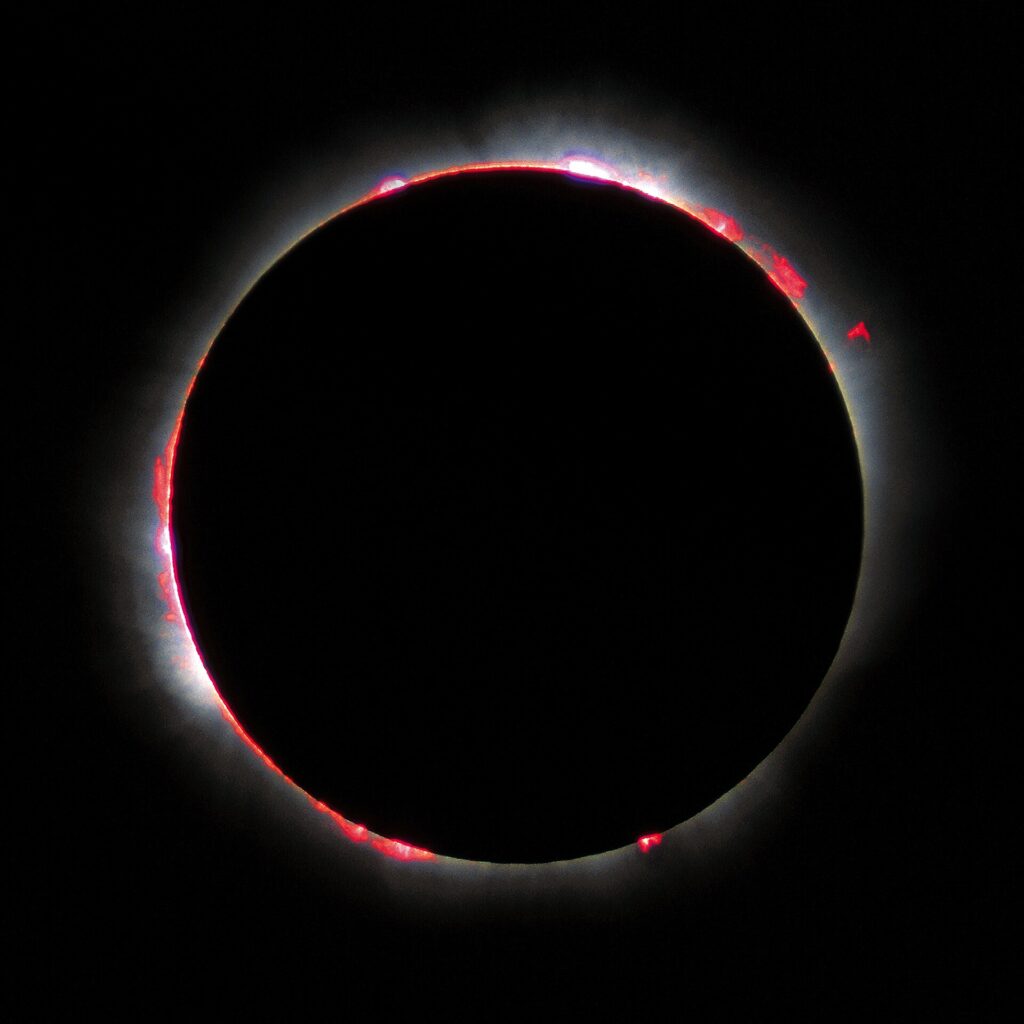
It hasn’t happened in over a century. The last total eclipse visible from Catalonia was in 1905, and it will happen again on 12 August 2026. From 19.35, the Moon will gradually cover the Sun until, at around 20.29, the solar disc will be completely hidden for approximately a minute and a half. During that brief interval it will grow dark in the middle of the evening, the temperature will drop slightly, Venus will be visible to the naked eye and the solar corona (the normally invisible outer layer of the Sun’s atmosphere) will emerge spectacularly around the black disc of the moon. The eclipse will travel across the Iberian Peninsula from west to east and will fade out just as it reaches southern Catalonia and northern Valencia, with the Camp de Tarragona and the Terres de l’Ebre districts being among the last places where it can be seen in its total form. The rest of the planet will see it partially, or not at all. However, those who want to witness it should take note: the Sun will be only five degrees above the horizon — the equivalent of three fingers’ width at arm’s length — so any obstruction, a building, some trees or a distant mountain, could spoil the moment. You must choose your viewing location in advance, with the western horizon completely clear.
The URV has taken the eclipse as an unprecedented opportunity for scientific outreach. Since the beginning of the year, ComCiència (the Science Communication and Outreach Unit) has promoted activities for its “Eclipsa’t de Ciència“ programme in collaboration with the University’s Extended Campus. Dozens of activities have been organised across the Camp de Tarragona and the Terres de l’Ebre districts, including talks, workshops, outreach videos, educational materials and observation sessions that have brought scientific knowledge to the University and public throughout the region. At the same time, URV researchers have published articles, participated in conferences organised jointly with the city councils of Tarragona and Reus, and put their expertise at the service of a region that, for a few minutes, will be one of the most privileged places on the planet. All this knowledge is brought together in eight chapters, one for each discipline, in a podcast, also promoted by Comciència, which premieres on Tuesday 14 July on Tarragona Radio and will be available on any radio station on the Xarxa network, as well as on the Ivoox and Spotify platforms.
The themes under discussion in the podcast range from the physics of astronomical bodies to the economic impact of mass tourism, eye health, the psychology of collective emotions, folklore, Greek mythology and medieval iconography. As such, the URV has demonstrated that the eclipse represents a real source of learning for all sorts of disciplines.
The perfect coincidence that makes the total eclipse possible
Carlos García, a researcher in the URV’s Department of Computer Engineering and Mathematics, asks a seemingly simple question: why does the Moon, which is up to 400 times smaller than the Sun, cover the Sun completely during an eclipse? The answer is that it is a matter of perspective and of an astronomical coincidence that makes the two celestial bodies appear the same size when viewed from Earth. García goes on to say that for us it is a double coincidence, because this effect occurs not only in space but also in time; that is, the Moon is moving away from the Earth very gradually and because of this, in the future, the Moon will be too far away to fully cover the sun during an eclipse. This means that observers in the future will only be able to witness annular eclipses, where a ring of sunlight appears around the lunar disc.
In fact, even now the slight eccentricity of the Moon’s elliptical orbit is enough to determine whether an eclipse will be total or annular: when the Moon is at the closest part of its orbit it appears large enough to cover the Sun completely, which is not the case when it is at the furthest part of its orbit. García goes on to add’ that the plane of the Moon’s orbit does not coincide exactly with the plane in which the Earth orbits the Sun, so that most months we see the Moon pass above or below the Sun without producing any eclipse’.
Only when the Moon crosses the plane of the Earth’s orbit between our planet and the Sun do the three bodies perfectly align, causing the Moon to cast its tiny shadow over the Earth’s surface and giving us a total eclipse. Such an alignment will happen on 12 August, explains García, and the Moon’s shadow, some one hundred and ninety kilometres wide, will pass over the southern regions of Catalonia, with just ninety seconds of totality in the places where it will be visible for the longest. During that minute and a half, the solar corona, the outer layer of the Sun’s atmosphere that is normally invisible due to its own brightness, will emerge spectacularly visible to the naked eye around the black disc of the Moon.
From the shadow of the Moon to the planets of other stars
This almost impossible coincidence of sizes, distances and times is our first point of entry into the eclipse. Fellow physicist and professor ad honorem at the URV, Manel Sanromà goes onto point out that, although the physical mechanism of an eclipse is relatively simple, it nevertheless impresses due to its suddenness. The shadow advances at nearly three thousand kilometres per hour, turning day into night with a visual violence that disconcerts even those who know exactly what is happening.
But the part that Sanromà finds most awe-inspiring goes far beyond the Earth and the Moon, indeed, far beyond the solar system. The same physical principle of an eclipse has allowed space telescopes to detect planets around other stars. How? When a planet, following its orbit, passes between its star and us, it obscures a tiny part of that star. From Earth, we perceive how the star’s brightness decreases by a minuscule but measurable fraction which the Kepler space telescope (operational between 2009 and 2018) was able to detect. It could discern changes in brightness equivalent to switching off a single light bulb in a city of one hundred thousand lights. Thanks to this technique, it is now estimated that the number of planets in the universe is one hundred thousand times greater than the number of grains of sand on all the beaches of Earth. Sanromà concludes that the eclipse of 12 August is not merely a local spectacle but is also an example of a phenomenon that has forever changed our understanding of the cosmos.
Cognitive reorganisation, social instinct and evolution
But while physics tells us what happens in the sky, it does not fully explain what happens to us on the ground. Urbano Lorenzo, professor of Behavioural Sciences at the URV’s Department of Psychology, explains that the emotional response provoked by a total eclipse has, from a psychological perspective, a purely cognitive explanation. When the sky goes dark in a matter of seconds—and not over the seventy or ninety minutes of a typical sunset—the brain receives information that doesn’t match any previously stored experience. The frontal lobe, which is responsible for reasoning and speech, is momentarily occupied with reordering its schema of the world: the sky is blue, it has always been blue, and suddenly it isn’t. Lorenzo states that this cognitive reorganisation is the cause of many spectators’ unusual behaviour during the totality phase, which psychologists have called deep fascination.
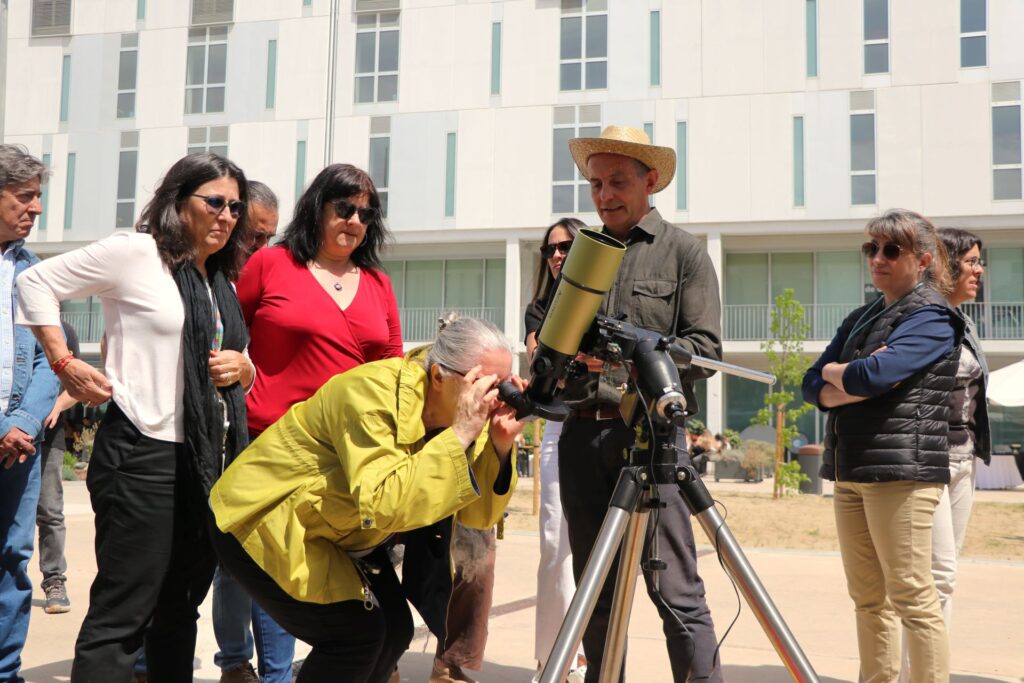
But Lorenzo goes further and points to two additional layers in the emotional response. The first is social: in the face of a phenomenon that exceeds their capacity for control, “people tend to feel small and start to engage in prosocial behaviours”. The second is evolutionary: people who are moved by extraordinary natural phenomena tend to be more sensitive and more adept at adapting to new situations. These characteristics, according to the researcher, made it more likely that a couple could care for their offspring in an evolutionary, natural selection context. In a way, Lorenzo concludes, “we are evolutionarily selected to be sensitive to this type of phenomenon.”
The researcher also points out that we must be prepared to manage the frustration that can arise from not seeing the eclipse, whether this is due to the weather or to other unforeseen circumstances: “We’ll need to be resilient and remind ourselves that we will have another opportunity to see one next year if we travel to the south of Spain or, better still, to North Africa.”
The retina doesn’t hurt when it’s burnt, and that’s a problem
The fascination with eclipses, however, has a dangerous side: the urge to look can conflict with the need to protect oneself, because an eclipse can have very real consequences for eye health. Pere Romero has been chosen by the Catalan Association of Ophthalmology as its spokesperson to promote eye safety during the eclipse. The URV researcher and head of the Ophthalmology department at the Sant Joan Hospital in Reus explains that eye damage from an eclipse does not hurt at the time it occurs because the macula, the central area of the retina where all detailed vision is concentrated, has no pain receptor, and that symptoms of damage appear between two and six hours later in the form of a dark spot in the centre of the visual field that affects both eyes at once. There is no treatment. The only option is to wait, and “in 90% of cases vision partially recovers within the first month, but there are cases that take up to six months and cases that never recover fully”. Romero illustrates this with the case of a ninety-year-old patient that he saw recently: the man had a retinal injury dating back to a partial eclipse he had watched without protection at the age of sixteen. Seventy-four years of silent injury.
What burns the retina is not visible light but ultraviolet radiation and, above all, high-energy blue light, which penetrates the photoreceptors of the fovea (a region about two millimetres in diameter at the centre of the retina) and causes an irreversible photochemical burn. Romero highlights two common mistakes that should be avoided: believing that clouds provide protection (they do not, as ultraviolet rays pass through cloud cover without any problem) and thinking that looking at it for just a moment will not harm you.
The solution is very simple, and it involves prevention in the form of protective glasses. The glasses approved for solar observation must carry the ISO 12312-2 certification and filter 99.99% of the light so that when worn, the sun appears small and dim. Romero adds a specific warning for the annular eclipse that will occur two years after the total one: in that case the solar ring is always visible and the glasses must not be removed at any point, unlike during a total eclipse, which can be observed with the naked eye during the full totality phase. The rule is simple, according to Romero: “Wear your glasses whenever the sun is not completely covered, and keep an eye on children, who tend to take them off without realising the danger.”
A minute and a half that the tourism sector must take full advantage of
While millions of eyes will be cautiously watching the sky, on the ground the eclipse will be affecting another area of activity, namely tourism and the economic impact of a once-in-a-lifetime event. Josep Maria Arauzo, URV professor of Economics, cautions that, although economists are usually much better at predicting the past than the future, we have enough experience of previous eclipses, especially in the United States, to sketch out likely scenarios.
The first thing he emphasises is that the impact will be profoundly uneven: the path of totality cuts across the country diagonally through the Camp de Tarragona, the Terres de l’Ebre and the Segrià districts, so outside this path the economic phenomenon will be virtually non-existent. By contrast, within the path of totality, there will be a boom in tourist demand concentrated over a very short period, with a visitor demographic that the Department of Economics researcher describes as relatively cultured and with spending power, not the usual sun-and-sand seekers, but people who have planned their trip specifically to see this event. The problem is that the eclipse will happen in the middle of high season, when hotels are already almost full, which limits their capacity to absorb new demand.
But for Arauzo, mobility will be the most serious challenge. Arrivals may be staggered over the preceding days, but departures will be massive and simultaneous, like when a big football match ends. The authorities will have to close access to viewpoints with limited capacity, manage sanitation and emergency services, and anticipate the risk of wildfires that comes from thousands of people gathering in natural environments in August. Furthermore, Aráuzo adds a variable that few forecasts take into account: if there is a storm on that day (something not unusual in the first half of August) the economic impact could vanish in a matter of hours.
But beyond 12 August, the economist sees in the eclipse a strategic opportunity for an inland stretch of the country that tourism has systematically ignored. If the regions are able to turn the minute and a half of totality into a broader cultural, astronomical and gastronomic experience, the phenomenon could have a much more lasting legacy.
The Sun devoured: from myths to the first rational explanation
Long before they became the subject of scientific study or a tourist opportunity, eclipses had already left a profound mark on the way cultures interpret the world. In this regard, Jesús Carruesco, a researcher in the URV’s Department of Catalan Philology, points to a fascinating finding: cultures that never had any contact with one another generated surprisingly similar explanations for an eclipse. In Vedic India, in Norse mythology, in Chinese tradition and in Indonesian cultures, the recurring theme is that of a malevolent being (a dog, a dragon, a demon, a severed head) that devours the Sun.
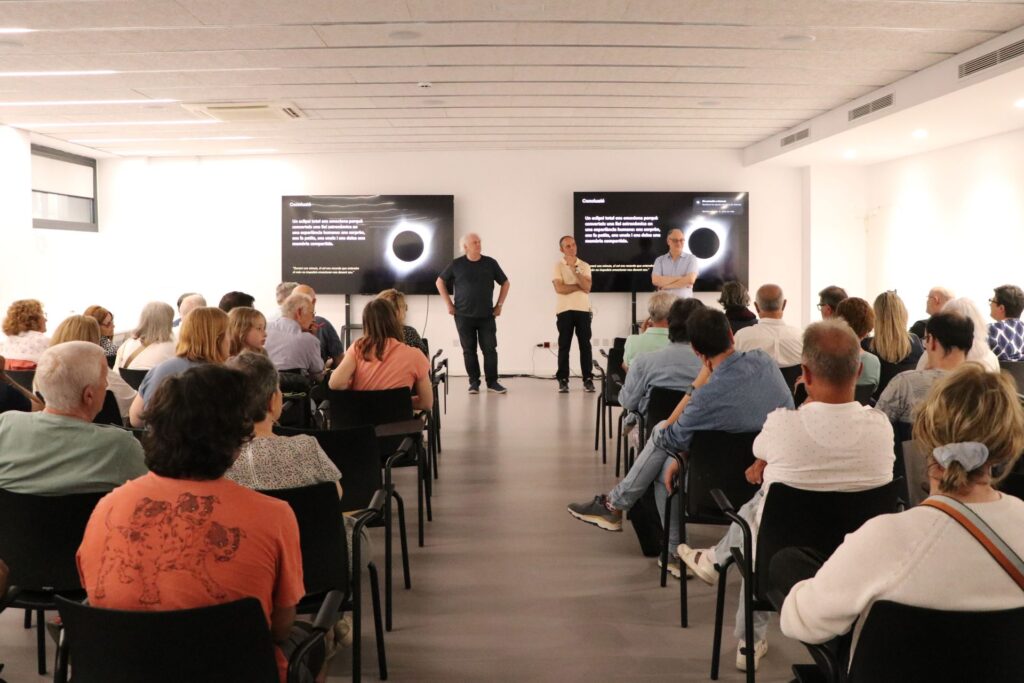
In Hindu mythology, the head of the demon Rahu, who was decapitated by Vishnu when he tried to steal the elixir of immortality, wanders eternally, pursuing the Sun and the Moon and from time to time swallowing them. Since this is done by Rahu’s head alone, without his body, the light emerges again from the other side. In Scandinavian mythology, two celestial wolves pursue the Sun and the Moon, and the day that they finally succeed in catching them for good will be the end of the world. In all cases, an eclipse is a moment of definite cosmic peril that provokes a human response in the form of ritual: shouts, noises, arrows launched into the sky to frighten the beast. And, since the Sun invariably shines again, the ritual seems to work.
What Carruesco finds particularly significant is the moment when Greece broke with this pattern. In the 5th century BC, the philosopher Anaxagoras declared in Athens that the Sun and the Moon were not gods but giant rocks, one of them incandescent, and that an eclipse was nothing more than one of these bodies obscuring the other. His claim caused him to be put on a trial for impiety, but it nevertheless paved the way for a more rigorous form of astronomy that was capable of predicting eclipses by discovering that they recurred in cycles of 223 months and which culminated in the Antikythera mechanism, an artefact recovered from the seabed in the early 20th century and which has turned out to be the first known example of an analogue computer. It is a bronze mechanical device capable of accurately calculating the positions of the sun, moon and planets and, therefore, of predicting eclipses. Carruesco sees in this leap from myth to mathematical prediction the first great intellectual revolution of humanity.
Fear, Power and Culture
This transition from myth to reason was neither homogeneous nor did it completely erase popular interpretations of the phenomenon, which have continued to coexist with science in specific local contexts. Emili Samper, also a researcher at the Department of Catalan Philology, speaks from his own area of expertise, Catalan popular culture. His first observation is of a significant absence. Unlike other traditions, Catalan culture has not generated great myths or legends to explain eclipses. What it does have, though, is a rich set of beliefs, superstitions and observations that show how peasant communities have experienced the phenomenon over the centuries: always as something negative, always as a breach of the natural order that will have consequences.
This fear is evident in the proverb “Signs in the sky, toil on the ground”, and a Venetian saying is even more specific: “An eclipse, whether of the Sun or the Moon, brings cold and never good fortune.” Hens would return to the coop and stop laying, medicinal plants would lose their properties, bread would not rise, and wine would spoil. Joan Amades, the great Catalan folklorist, also recorded the widespread belief that if a pregnant woman touched her belly during an eclipse, the child could be born with a birthmark on their body. Samper points out that all these beliefs share the same underlying logic: when the Sun is obscured, the natural properties of things are altered.
Samper also reflects on the use of eclipses in fiction and literature, and takes a micro-story by the Guatemalan writer Augusto Monterroso as an example to support a particular thesis. In the story, a Spanish friar lost in the Americas is about to be sacrificed by a group of indigenous people and, remembering that there is to be a total eclipse that day, threatens to darken the sun if they kill him. The indigenous people listen to him in silence, the sun darkens… and they kill him anyway. What the friar did not know was that the Mayan astronomers already knew about the cyclical nature of eclipses and had predicted that date long ago. The tale therefore subverts the trope of knowledge as a tool of power, which in Western culture, from Mark Twain to Tintin, has often been presented as the thing that separates enlightened man from the “ignorant primitive”. In this case, the ability to predict an eclipse turns out to be knowledge that is already possessed by independent cultures around the world.
From the crucifixion to the dollar: the eclipse as a metaphor in art
This dialogue between knowledge, belief and power has also left a profound mark on Western art. Over the centuries, painters and artists have depicted eclipses both as real astronomical phenomena and as symbols laden with religious, political or social significance.
Licia Buttà, a researcher in the URV’s Department of History and Art History, describes the evolution of the iconography of the eclipse. Her starting point is the Metz Sacramentary, an 11th-century manuscript that poses a fundamental question: how could an astronomical phenomenon be represented in an era when the actual movement of the heavenly bodies was not yet conceived? The medieval answer was allegory, that is, representing the phenomenon through symbolism.
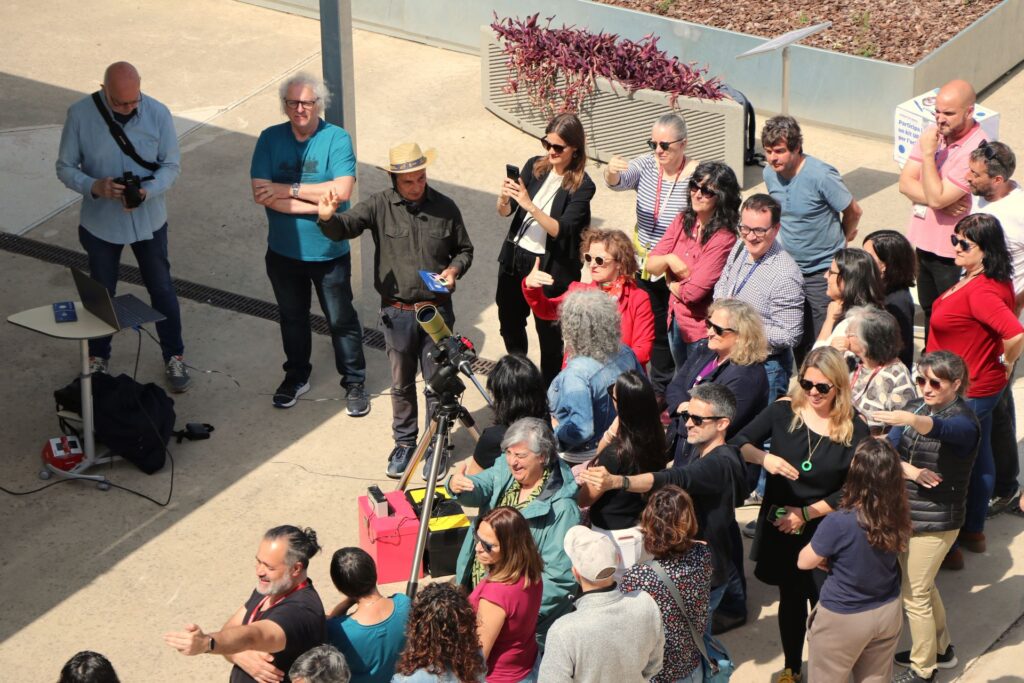
The theological context was also crucial. The three Synoptic Gospels (Matthew, Mark and Luke) explain that, during Christ’s crucifixion, the Sun was darkened for three hours. For centuries, the Church Fathers rejected the idea that this phenomenon could have been an eclipse because an eclipse is a natural and predictable event, whereas the death of Christ was meant to be a supernatural phenomenon. It was not until the 13th century, at the University of Paris, that Church authorities began to accept the possibility that the phenomenon described during the Passion was a real eclipse. This change paved the way for a new iconography in which science and faith coexisted in the same image.
From this point on, Buttà shows how various artists incorporated real or symbolic eclipses into their works. Rafael was probably inspired by the eclipse of 8 June 1511 to paint the meeting of Isaac and Rebekah, while Rubens depicted a partial eclipse in The Elevation of the Cross to accentuate the drama of Christ’s death. In the 19th century, Romantic painters turned eclipses into a luminous device within grand landscapes, while the Symbolists used it to explore the effects of nocturnal light on crowds.
Buttà’s journey culminates with two 20th-century works that exemplify new uses of the phenomenon. In a 1926 painting by Georg Grosz, set in the Weimar Republic, headless politicians listen to a demagogue’s speech while a donkey, symbolising the populace, devours newspapers and fake news. The eclipse that darkens the sky is not caused by the Moon but by a dollar: a metaphor for economic power. In contrast, Roy Lichtenstein turns the eclipse into an abstract and accessible pop icon.
From medieval fears to political criticism, from religion to science, solar eclipses have always been much more than an astronomical phenomenon; they have been used to symbolise and reflect the anxieties of each era.