03/06/2026
Fever and chills can make respiratory diseases more contagious
A study by URV reveals that when the difference between body temperature and the ambient temperature is greater, the clouds of particles generated by coughing or sneezing disperse more and maintain a higher concentration
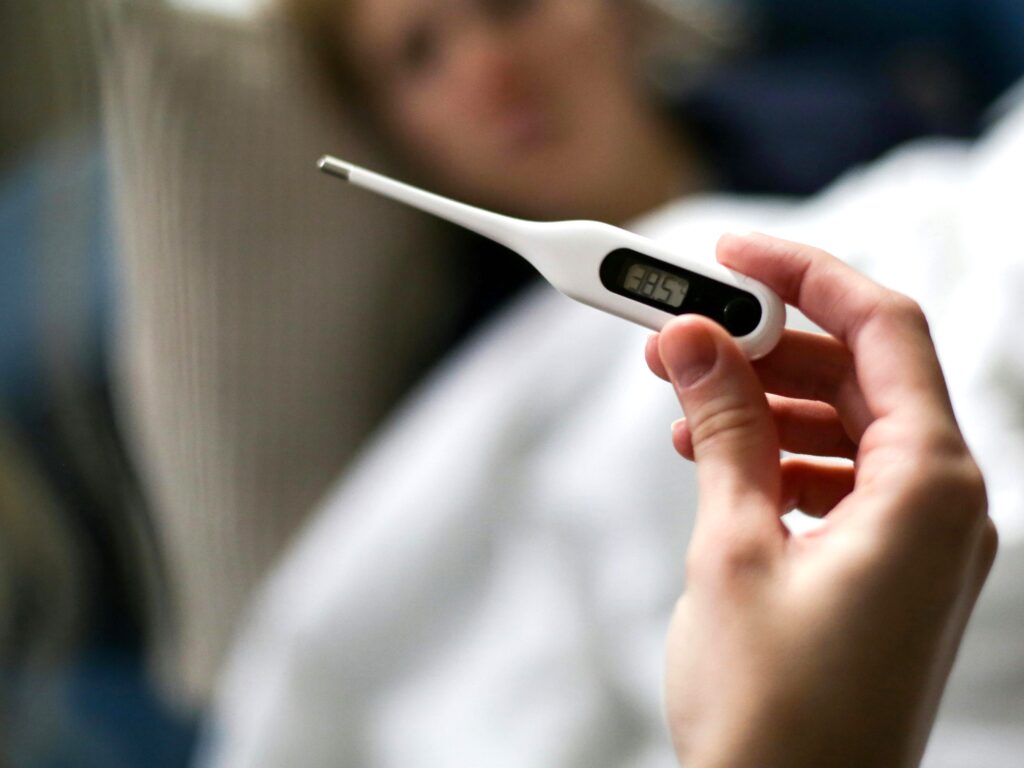
A study by URV reveals that when the difference between body temperature and the ambient temperature is greater, the clouds of particles generated by coughing or sneezing disperse more and maintain a higher concentration
When a person coughs or sneezes, they expel a cloud of microscopic particles capable of carrying viruses and bacteria that act as vectors for respiratory diseases such as flu, COVID-19 or tuberculosis. Understanding how these aerosols disperse in the air is crucial for minimising the transmission of pathogens in indoor spaces, but their dynamics are complex and depend on many factors: the force of the exhalation, the morphology of the respiratory system, the characteristics of the space, etc. Now, a new study led by researchers from the Universitat Rovira i Virgili has shown that temperature also plays an important role.
Their findings indicate that the difference between the temperature of exhaled air and that of the ambient air causes the cloud of particles to remain more concentrated and travel further. The greater this difference, the more noticeable the effects are. The research continues a line of work initiated by the URV’s ECoMMFiT research group, which developed a simulator capable of reproducing coughs and sneezes to study how respiratory aerosols disperse. As a result of that study, the team demonstrated that the nasal cavity significantly alters the trajectory of expelled particles. Now, the researchers have incorporated a new factor into the analysis: temperature.
To do this, they modified the simulator to heat the exhaled air to 37 °C, a temperature that mimics that of a person with a slight fever. The experimental phase was carried out inside a climate chamber at the Catalonia Institute for Energy Research (IREC), where the URV researchers were able to recreate different controlled environmental conditions. More specifically, they studied the behaviour of respiratory aerosols in environments at 27 °C, 17 °C and 7 °C, combining these temperatures with different exhalation intensities and the two simulator configurations: sneezing with the nasal cavity open and sneezing with it closed. In total, they analysed eighteen different experimental configurations, each repeated ten times to ensure the reliability of the results, thus meaning they completed 180 experiments.
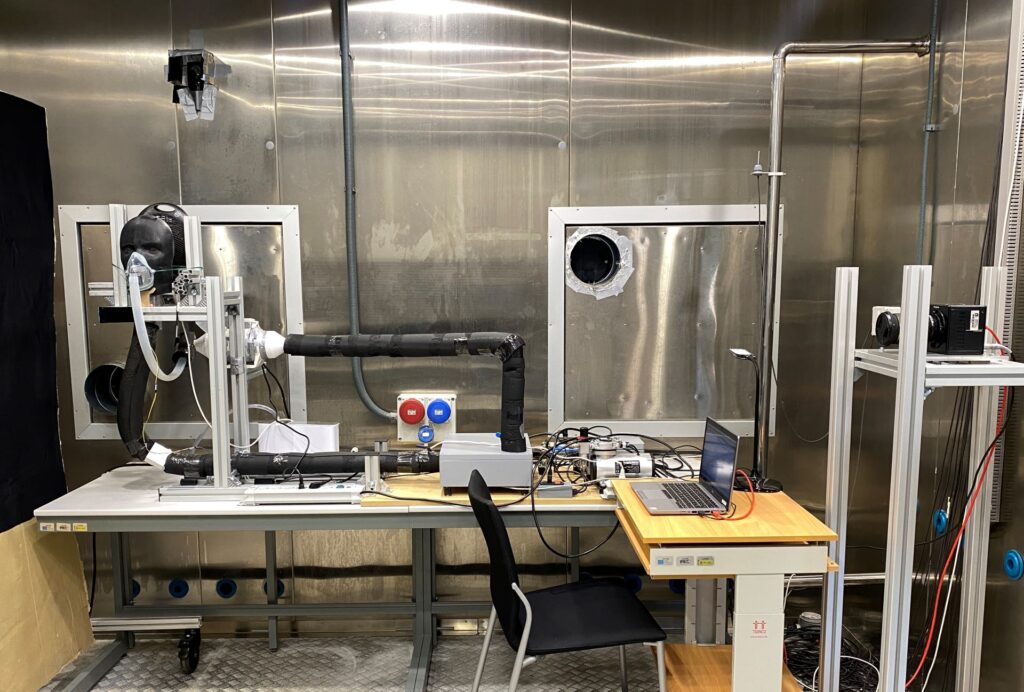
“We wanted to understand to what extent ambient temperature can alter the dynamics of particle clouds,” explains Nicolás Catalán, a researcher in the URV’s Department of Mechanical Engineering and co-author of the study. “What we observed was that, when the temperature difference between exhaled air and ambient air increased, the cloud remained more cohesive and traveled greater distances,” he adds. This understanding of how pathogens are transmitted through the air can contribute to the design of more efficient safety protocols, ventilation systems and control strategies. The results could be particularly useful in sensitive indoor spaces, such as schools, hospitals, biological laboratories or public transport, where the risk of respiratory disease transmission is higher.
To record these phenomena, the research team used high-speed cameras and laser lighting systems, which allowed them to visualise and record the aerosol dispersion in detail. The images showed how, in cold environments, the density differences between the warm exhaled air and the ambient air generate buoyancy forces that modify the trajectory and structure of the respiratory particle cloud. This causes the concentrations of the aerosols to remain higher for longer and to travel further before dispersing completely.
The nose plays a decisive role
The study also confirmed that the geometry of the respiratory system remains a determining factor. When the airflow passes partially through the nose, the horizontal range is reduced and vertical dispersion increases. In contrast, when exhalation occurs exclusively through the mouth, the cloud tends to advance more horizontally. This combination of temperature, exhalation intensity and nasal involvement generates very different dispersion patterns depending on the environmental conditions.
In addition to its results, the research provides experimental data that are uncommon in this field. Until now, many studies on respiratory aerosols had relied on numerical simulations or experiments with human volunteers, making it difficult to precisely control variables such as flow rate, temperature or respiratory geometry. The simulator developed by the URV allows these conditions to be reproduced stably, thus generating highly valuable data to feed computational models capable of more accurately simulating aerosol dynamics and the transmission of respiratory diseases.
However, the researchers stressed that the actual behaviour of respiratory aerosols is extremely complex and that research must continue into factors such as humidity, ventilation, and the persistence of suspended particles.
Reference: Catalán, N., Cito, S., Varela Ballesta, S., Fabregat, A., Vernet, A., Graus, D., & Pallarès, J. (2026). Bioaerosol transport dynamics in cold and warm environments: An experimental study using a three-dimensional-printed human airway model. Physics of Fluids. https://doi.org/10.1063/5.0303143
