27/01/2026
Oldest hafted stone tools in East Asia discovered in China
A study published in Nature Communications, with the participation of IPHES-CERCA and URV, documents composite technology dating back 160,000 years
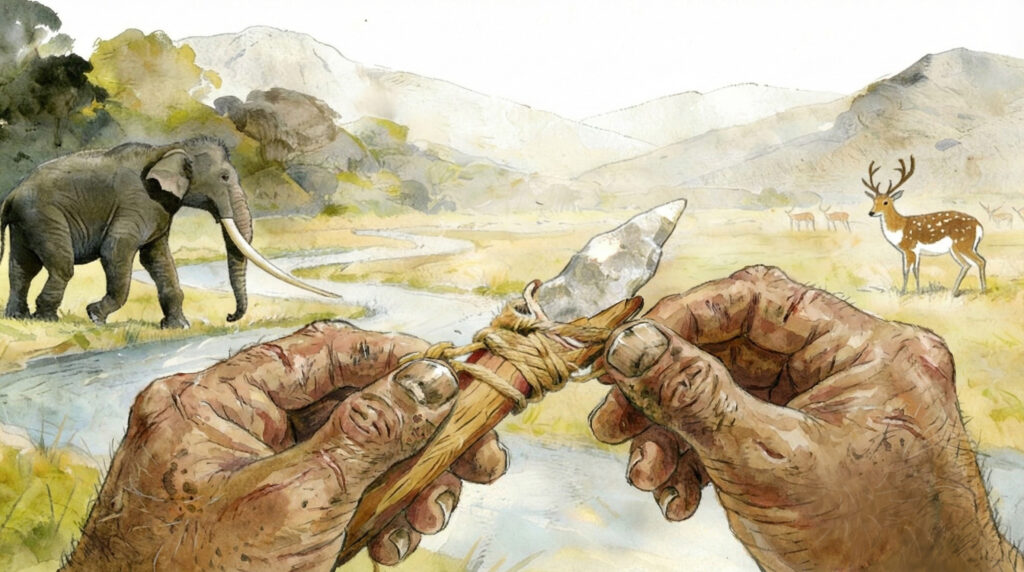
A study published in Nature Communications, with the participation of IPHES-CERCA and URV, documents composite technology dating back 160,000 years
Human populations living in central China between 160,000 and 72,000 years ago were already producing stone tools designed to be hafted, a key technological innovation in human history that until now was believed to have emerged much later in East Asia.
This is the main conclusion reached by an international team led by Jian-Ping Yue, researcher at the Institute of Vertebrate Paleontology and Paleoanthropology (IVPP) of the Chinese Academy of Sciences, and Guo-Ding Song, from the College of Applied Arts and Science at Beijing Union University. The study, published in the journal Nature Communications, includes a significant contribution by Andreu Ollé, researcher at IPHES-CERCA and associate professor at the Universitat Rovira i Virgili (URV), a specialist in lithic technology and microscopic use-wear analysis of stone tools, as well as Juan Luis Fernández-Marchena, a postdoctoral researcher at the Fundación Atapuerca linked to IPHES-CERCA.
The research provides the oldest known evidence of hafted tools in East Asia and challenges the traditional view of the Chinese Palaeolithic as technologically simple or conservative. Far from representing an isolated episode, the results show that hafted technology was part of a complex technical tradition maintained for almost 90,000 years, from the late Middle Pleistocene to the early Late Pleistocene.
A key site for rethinking technological innovation
The study focuses on the Xigou site, located in the Danjiang River region of central China, within an archaeologically rich area known as the Danjiangkou Reservoir Region. At this site, researchers analysed more than 2,600 stone tools using a multidisciplinary approach combining geoarchaeological and chronological studies, technological and typological analysis, and functional studies. The latter are based on microscopic observations of use-wear traces and on reference experiments.
The results indicate that the human communities who occupied this environment developed sophisticated stone-knapping strategies, primarily aimed at producing small standardised tools. Of particular importance are reduction methods using flake cores and discoidal cores, which reflect a high level of technical control and careful planning of the manufacturing process. In addition, the raw material used was quartz, a material that poses extra challenges in terms of knapping and product standardisation.
These strategies coexist with a wide diversity of retouched tools (such as scrapers, perforators, denticulates and points), demonstrating the existence of established technological traditions passed down through many generations.
Hafted tools: a complex and planned technology
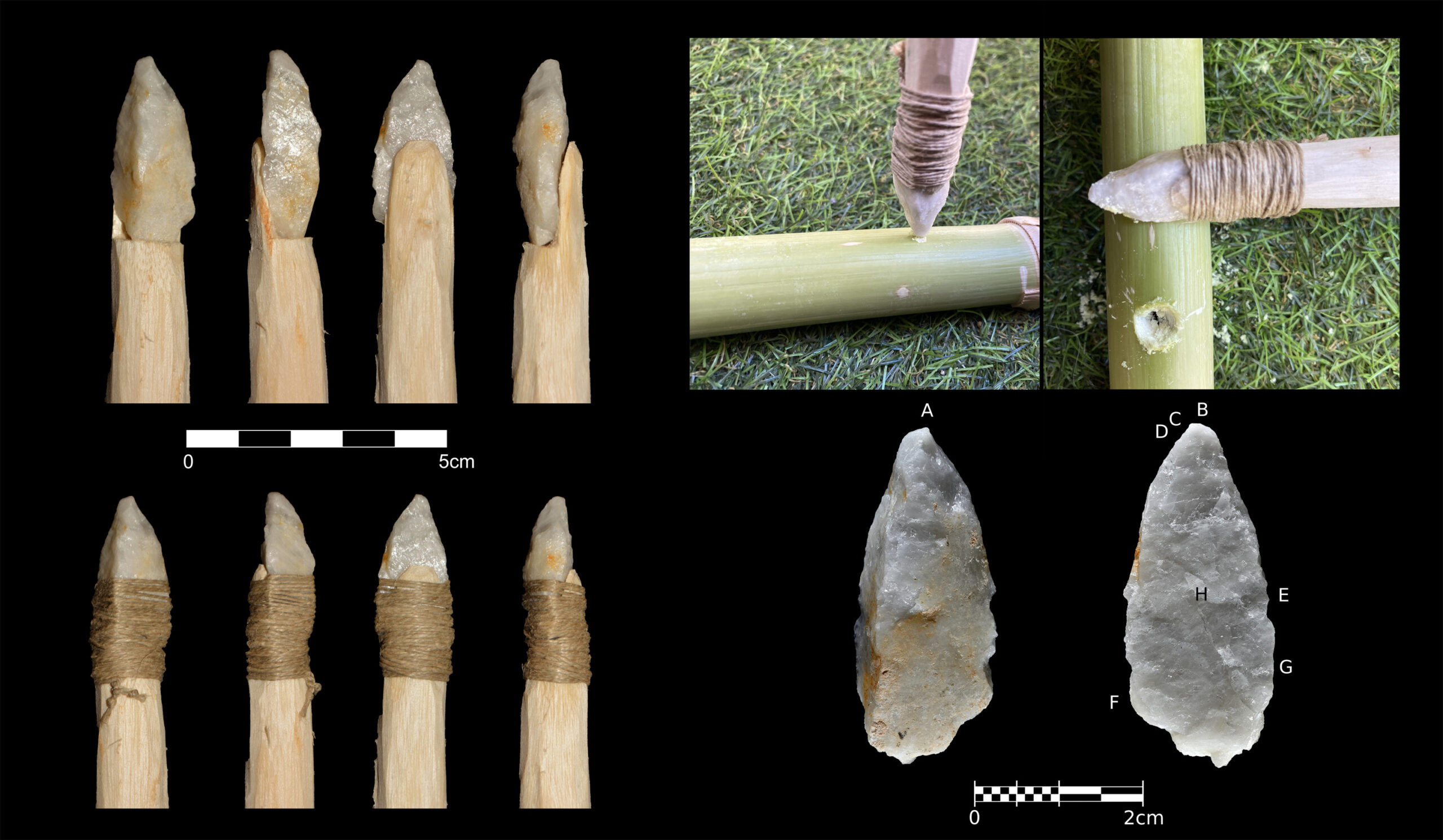
One of the most relevant aspects of the study is the identification of tools specifically designed to be attached to handles or organic supports. In this area, the contribution of IPHES-CERCA and URV researchers Andreu Ollé and Juan Luis Fernández-Marchena was key, particularly in the microscopic analysis of use-wear traces and hafting systems.
Use-wear analyses documented two different hafting modes: juxtaposed hafting (with the lithic piece resting in a notch at the end of the handle) and terminal “male” hafting (with the element fully inserted into the handle). In both cases, plant or animal binding elements were used, with or without the presence of an adhesive product. This implies multi-stage planning, precise technical execution and an abstract conception of the final tool—clear indicators of advanced technological behaviour.
In addition, the use-wear traces reveal that these tools were used for a range of activities such as perforating, cutting or working plant materials, demonstrating their functional versatility and the efficiency of these technological solutions.
Exceptional continuity for nearly 90,000 years
Rather than reflecting a sporadic innovation, the archaeological record at Xigou shows exceptional technological continuity for almost 90,000 years. This persistence suggests the existence of systems for transmitting technical knowledge and a remarkable capacity to adapt to changing environments.
Researchers highlight that this technological stability contrasts with the traditional idea that complex innovations emerged only late in East Asia, placing these populations on a par with other key regions of the prehistoric world.
A robust chronology in a complex evolutionary context
To establish the age of the site, the team applied several luminescence dating methods to six sediment samples. Quartz-based ReOSL dating reliably places the archaeological layers between 160,000 and 72,000 years ago, providing a solid chronological framework for interpreting the documented human activity.
This period coincides with a phase of great human diversity in China, also reflected in the fossil record, with hominin populations showing large cranial capacities documented at sites such as Lingjing or Xujiayao. Often associated with archaic human forms (such as Homo juluensis and Homo longi), Denisovans and possibly early Homo sapiens populations, these communities display complex technological responses comparable to those documented in other regions of Africa and Eurasia.
Reference: Yue, JP., Song, GD., Yang, SH. et al. Technological innovations and hafted technology in central China ~160,000–72,000 years ago. Nature Communications (2026). DOI: 10.1038/s41467-025-67601-y
