28/05/2025
Takanori Shibata, creator of Nuka, the robot seal, visits the URV to explain its therapeutic use
Shibata took part in a conference as part of the MyRobot project, which uses his therapeutic robot to improve the quality of life of elderly people living in care homes
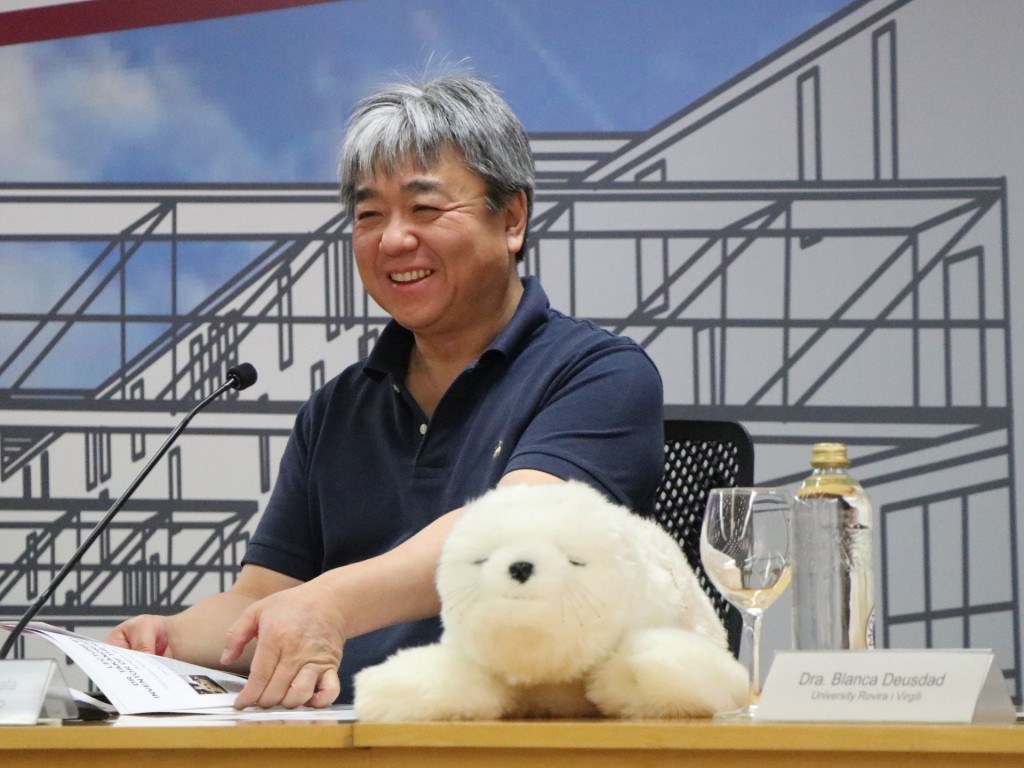
Shibata took part in a conference as part of the MyRobot project, which uses his therapeutic robot to improve the quality of life of elderly people living in care homes
In recent years, social robots have become an attractive tool for therapeutic support. They are gradually being introduced into the care sector to complement the work of professionals in caring for elderly people with dementia and to accompanying cancer patients during their treatment and children admitted to paediatric wards. A notable example is Nuka, a robot that looks like a baby seal, developed by Takanori Shibata of the Intelligent Systems Research Institute in Japan.
Aware of the potential of this companion robot, the Department of Anthropology, Philosophy and Social Work at the URV is conducting a study to assess the impact of Nuka on the quality of life and environment of elderly people with dementia. Although previous research has found that the robot has a positive effect in situations where patients are experiencing anxiety or aggression, the URV team is studying its ability to influence social dynamics and promote the inclusion of people in the community.
Shibata has revealed that his initial goal was to develop a robot that could be used daily in the home environment and that would be easily accepted by people. In this regard, during the conceptualisation process, he ruled out designing robots to do jobs such as cleaning or cooking, which can be very expensive and complex to manufacture and maintain. ‘That’s when I thought about developing something useless in productive terms; and what do we have in our daily lives that is like that? Pets.’ explained Shibata, who is a Senior Principal Researcher at the National Institute of Advanced Industrial Science and Technology in Japan. As a result, in the 1990s, with a therapeutic goal, in mind he began to develop an animal-like robot that was “useless” but which would “enrich our lives,”: ’We don’t expect pets to do work for us, and yet we love them.’
Japan, where both Takanori Shibata and Nuka come from, is known for having one of the oldest populations in the world. This is undoubtedly a factor that played an important role in the robot’s development. Shibata points out that there is evidence of Nuka’s benefits in improving the quality of life of elderly people who need assistance, but he goes further and says that it can also be a great pet for older people in general: ‘Many people who have had a pet in the past would like to have one again, but cannot because of the work it involves; Nuka does not require this commitment,’ he says, emphasising the robot seal as a good alternative for these people.
Shibata’s interest in the MyRobot project came after it was presented to him by the researchers from the Department of Anthropology, Philosophy and Social Work, prompting him to say that he is looking forward to comparing the results with what is happening in Japan: ‘Every country has a different culture, and that includes the relationship with animals and family lifestyle.’
Nuka’s case is not common in the robot industry. It came onto the market more than twenty-five years ago is still, today, a benchmark in the field of therapeutic technology. The Japanese researcher explains, however, that although its appearance has not changed, there are constant updates: ‘Perhaps people don’t realise it, but inside, the technology is very different from that of the early 2000s.’ Manufactured by Intelligent Systems, the robots are designed in line with Shibata’s concern for people’s safety and privacy. Nuka is not connected to the internet and does not have a built-in camera, precisely to respect these rights. ‘We expect a lot from new technologies, but they are not always necessary. Sometimes they can even cause inconvenience,’ he reflects, while highlighting his robot’s balance between technology and practicality.
Finally, the Japanese researcher pointed to the need to gather scientific evidence on the use of companion robots to improve people’s lives, particularly among younger population groups: ‘We need to do more studies on young people and adults to find out how we can improve the way we use Nuka, and thus improve its effect on therapeutic aspects or learning skills.’
