13/08/2025
URV researchers develop a maintenance-free home alarm system
Researchers at the Universitat Rovira i Virgili combine two highly efficient technologies to offer a sustainable alternative to Internet of Things systems
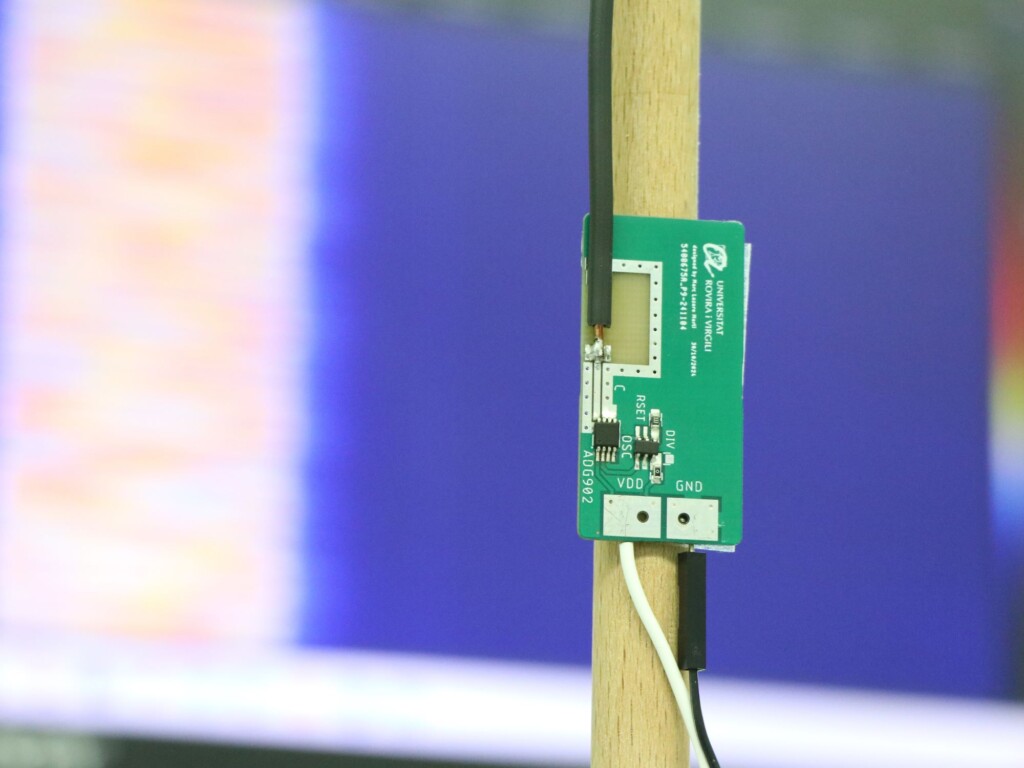
Researchers at the Universitat Rovira i Virgili combine two highly efficient technologies to offer a sustainable alternative to Internet of Things systems
Fridges, washing machines, thermostats, lighting and alarm systems. It is now commonplace for all types of household appliances to be connected to the internet. This is the Internet of Things (IoT), a network of physical objects with sensors and processing capacity that exchange data via the internet or other communication networks with the aim of automating tasks, improving decision-making and making processes more efficient, among other things. The trend is by no means limited to people’s homes. It is also beginning to reach other kinds of applications, for example in smart cities (traffic management, public lighting, air quality), in industry (stock control, predictive maintenance) or even in agricultural settings (weather sensors, smart irrigation, pest control).
While the potential of data technology to improve people’s efficiency and quality of life is undeniable, it nevertheless raises questions regarding energy consumption. Basically, the sensors in a given system each consume energy, and they cannot always be connected to the electricity grid. They therefore need batteries, elements which have a limited useful life, that have a high environmental impact during their manufacture and which, once no longer useful, need to be disposed of correctly. Moreover, sensors are often located in places that are difficult to access, which can make maintaining them difficult and costly. To tackle these problems, researchers from the URV’s Department of Electrical Engineering, Electronics and Automation have come up with a solution that combines two highly energy-efficient technologies: LoRa and backscattering.
LoRa (Long Range) is a data transmission technology known for its long range and relatively low transmission rate. It is an ideal solution in applications where constant data transmission is not required, as is the case with monitoring sensors, and it is robust in terms of security. Backscattering communication technology, on the other hand, is based on the reflection of electromagnetic fields. Instead of transmitting a signal, which requires a lot of energy to power the transmitter circuits, it uses devices called RFID (radio frequency identification) tags to reflect a specific radio signal. The tags modulate the radio signals, which allows the receiver to determine which tag the information came from. These RFID systems are becoming increasingly popular and are used, for example, as burglar alarms in shopping centres.
A super-efficient alarm system
To test the performance and feasibility of combining the two technologies, the research team applied them in a domestic alarm system. The proposed design used opening sensors that monitor the status of doors and windows. As these sensors are only activated sporadically, they are ideal for testing the application of this low-consumption technology. The system consists of a central device that sends and reads LoRa signals and a series of peripheral sensors. The central system monitors the status of doors or windows that have been fitted with RFID tags. When a sensor registers a change in status, it activates the radio frequency identification tag. This reflects the radio signal from the LoRa emitter and modulates it so that the receiver identifies which door or window has been opened.
But doesn’t this process consume energy? Yes, but so little that these peripheral devices do not need to be powered by a battery. Instead, the researchers of the NEPHOS group have opted to use a supercapacitor. These electronic components store electric energy in smaller quantities than batteries, are less harmful to the environment when manufactured and have a much longer life than conventional lithium batteries. To keep the supercapacitor charged, each sensor has a small photovoltaic cell that works with ambient light – in the same way that some calculators do. Since most of the time the sensor does not register movement and does not have to activate the RFID tags, the system can accumulate energy for the next intervention.
After designing the system, the URV team implemented it, first in the laboratory, where they tested the supercapacitor’s charging time and the capacity of the sensors to operate in low-light conditions. They found that the system has an extremely low power consumption, meaning that ambient light can be used to power the devices. They also found that the supercapacitor can provide energy to the system for more than twenty hours when there is a total absence of light, offering sustained protection over time. “The system is invisible to the user, and once installed it works autonomously and practically indefinitely,” says Marc Lázaro Martí, a researcher at the URV’s Department of Electrical Engineering, Electronics and Automation.
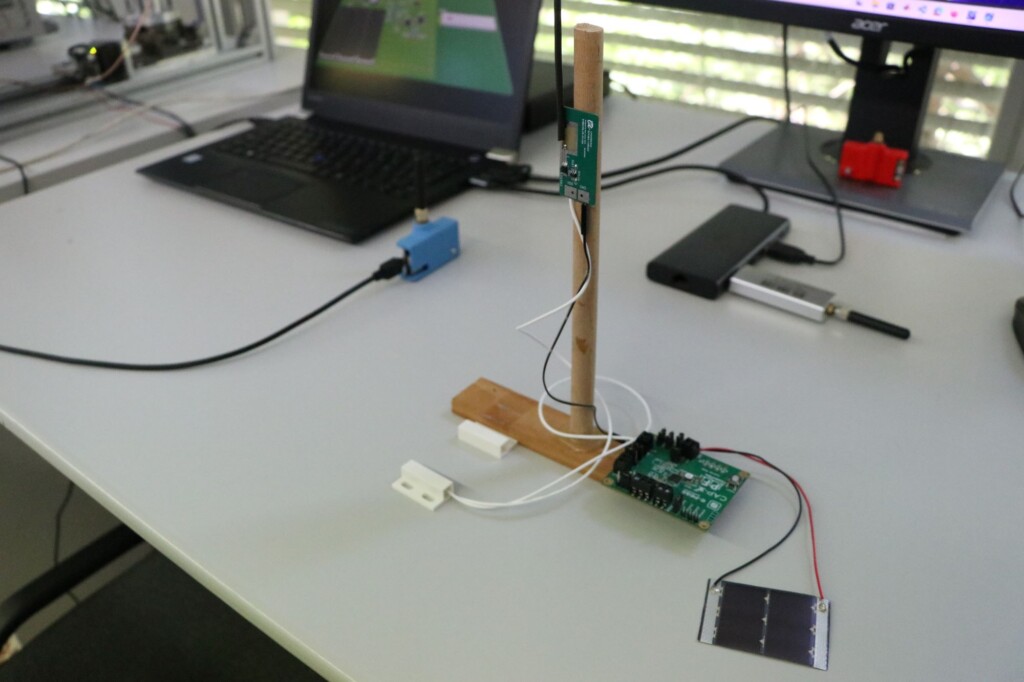
After the lab tests, it was time to move the design into the home environment. The researchers tested the system’s resistance to interference and the coverage capacity of the LoRa technology, which proved to be particularly suitable for indoor applications. The system worked well over linear distances of more than 80 metres and proved to be totally reliable in a 150 square metre floor. In terms of the system’s scalability, its potential is astonishing; it can support and identify more than 600 sensors on the same frequency channel, a capacity that is beyond the reach of conventional systems. One might expect that, with such high performance, this would be an expensive technology, but this is not the case; the cost of each sensor is around twenty euros.

Beyond security
This research, published in an article in the journal Scientific Reports, paves the way for the application of virtually maintenance-free, user-invisible systems in all kinds of sectors. It is a particularly attractive solution in situations requiring customised installations or where the system has to located in a hard-to-reach place that makes it impossible to carry out adequate maintenance. The possibilities are almost endless: traffic monitoring, smart agriculture, wearables and implanted medical devices, among many others. If the trend to connect everything is here to stay, more solutions like this one need to be found so that it can be done in the most sustainable and environmentally friendly way possible.
Reference: Lazaro, M., Lazaro, A., Villarino, R. et al. Home surveillance system based on LoRa backscattering. Sci Rep 15, 12063 (2025). https://doi.org/10.1038/s41598-025-96624-0
