27/10/2026
Nursing as an academic career finally breaks the glass ceiling
María Jiménez is the first member of the teaching staff of the URV’s Faculty of Nursing to be appointed Full University Professor. This marks the culmination of a collective effort by the nursing department and consolidates the University's academic standing

María Jiménez is the first member of the teaching staff of the URV’s Faculty of Nursing to be appointed Full University Professor. This marks the culmination of a collective effort by the nursing department and consolidates the University's academic standing
María Jiménez from the URV’s Department of Nursing has become the first person to be appointed full university professor of this discipline at the University. This achievement marks a turning point for the discipline and for the academic careers of nursing professionals. Reaching this position has been particularly difficult for nurses because until 2009 nursing studies finished at the diploma level, a qualification that did not allow them direct entry to study for the doctoral degree that they need to possess in order to be appointed full university professor.
Before the implementation of the European Higher Education Area (EHEA), researchers who wanted to pursue a research career in Nursing often had to complete a second university degree in another discipline in order to be appointed to a research position. This was the case for Jiménez, who also trained in Anthropology, and for the researchers who preceded her.
“That is not to say that research in Nursing was not being carried out before,” assert Dolors Burjalés and Josep Barceló, Dean of the Faculty of Nursing and Head of the Department of Nursing, respectively. Those who did so were healthcare professionals who decided to embark on an academic career out of an interest in the caring professions, in demonstrating the rationale behind what was being done and in improving patient care.
In fact, such was the commitment of these early researchers at the URV that, even before the Bologna Plan was implemented, they had established an agreement with the HZ University of Applied Sciences in the Netherlands that enabled them to study for a master’s degree and gain access to the doctoral programme. Nevertheless, the EHEA made everything so much easier. In fact, as Burjalés and Barceló point out, it will soon be 20 years since the Official Postgraduate Programme in Nursing was established, laying the foundations for what are now the Master’s Degree in Nursing Science Research and the Doctoral Degree in Nursing and Health, which has seen more than 100 theses defended.
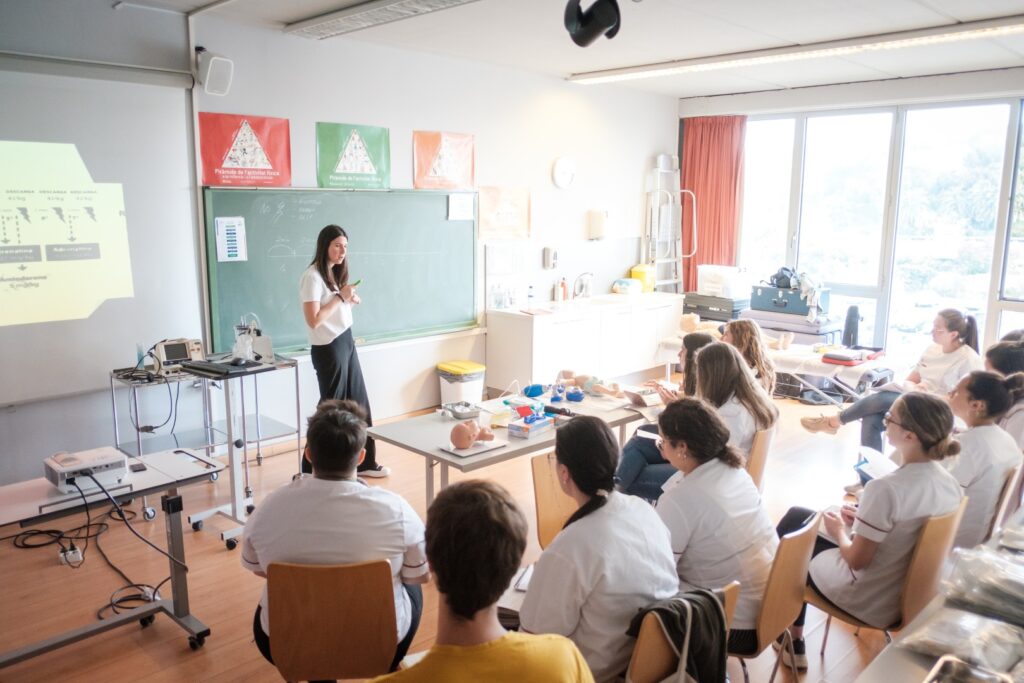
In 2012, the School of Nursing in Tarragona became a faculty and began to be governed by the same staff accreditation criteria as all the other URV faculties. Fourteen years later, the Faculty of Nursing has the broadest presence of all faculties across the URV, with facilities on four different campuses (Tarragona, Tortosa, El Vendrell and Vilafranca) providing training for 1,087 undergraduate, 74 master’s and 60 doctoral students.
For María Jiménez, becoming a full university professor is the fruit of all this collective work to advance the discipline of Nursing. Along the way, the challenge was not only to secure the presence of nurses in all academic areas, including examination panels, but also to convince members of other health disciplines that nursing is a science in its own right and that the caring sciences straddle humanism and biomedicine. Now, however, the scenario has changed.
We can now tell our teaching staff that if they decide to go in for a full university professorship, they will be assessed by their peers
When she first set out on her career in 1990, Jiménez had to juggle working in the Emergency Department and the Post-Operative and Critical Care Unit at Joan XXIII Hospital in Tarragona with teaching as an adjunct lecturer at the URV. This phase took a turn when, in 1997, Carme Nogués, then director of the School of Nursing, offered her the opportunity to train and specialise in ethics.
Now María Jiménez is a leading figure in the field of clinical ethics, explaining how “in the United States, this is a speciality that deals with how to do things better without being punitive.” Consequently, she has helped establish the foundations of evidence-based care to prevent errors and to redress harm, a task that she has been well qualified to do because of her experience of work in a clinical setting (she has worked in the Forensic Medicine Unit at Vall d’Hebron Hospital), because of her qualifications (she holds a Master’s Degree in Bioethics and Law and a Diploma in Criminology) and because of her research at the URV.
She does not just pass on her knowledge at the URV, she is also a visiting professor at the University of Borås in Sweden, where, in her classes with bachelor’s, master’s and doctoral students, she takes an intercultural perspective to issues relating to bioethics, organ transplantation and euthanasia, among others. “To outsiders, Spain is a multicultural country, because within there is a lot of diversity within the same country and its health systems too,” she summarises.
The fact that a research career in Nursing only became possible at the URV relatively recently means that the discipline is still “in its infancy in some respects”, says Jiménez, although she goes onto highlight that the path is now open for anyone who wants to embark on it: “Now you don’t have to choose between the clinical or academic fields; you can combine both or specialise in either one. It’s not easy, but it’s not impossible either.”