05/11/2025
The Social Anthropology Group Seminar holds the first session of the academic year
With the title ‘Algunas de las nuevas miradas’, this session featured contributions from some of the new lecturers at DAFiTS: Elisa Alegre, Daniel Malet and Laia Ventura.
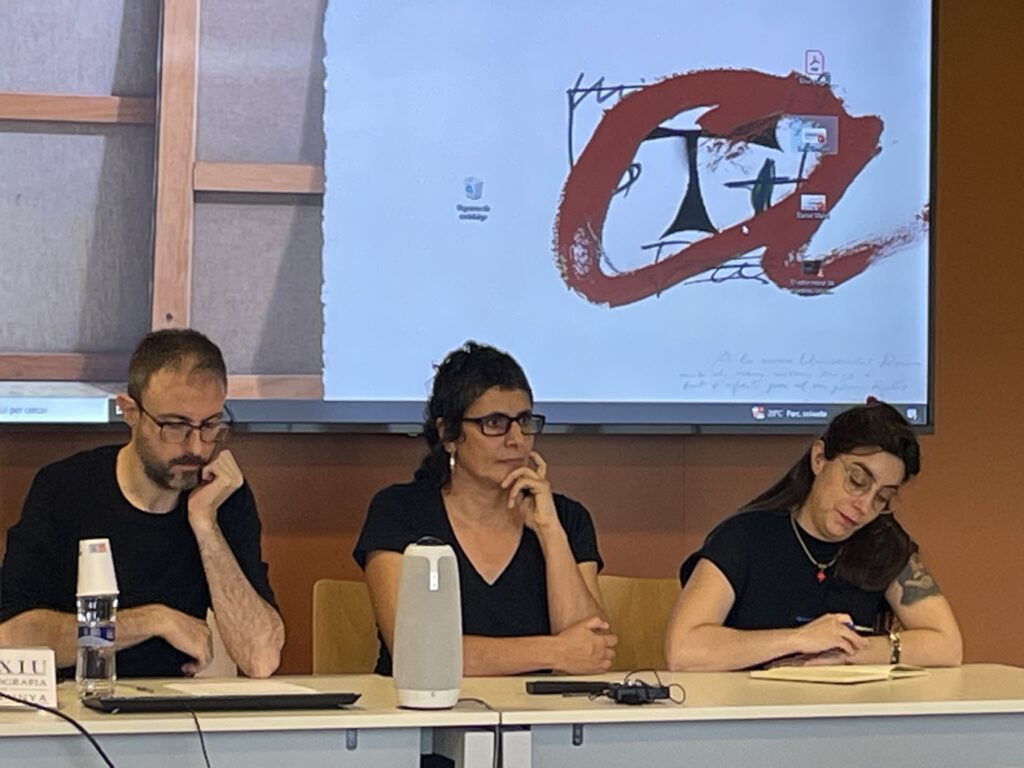
With the title ‘Algunas de las nuevas miradas’, this session featured contributions from some of the new lecturers at DAFiTS: Elisa Alegre, Daniel Malet and Laia Ventura.
With the coordination of Jaume Vallverdú, director of the Department of Anthropology, Philosophy and Social Work, the first session of the 2025-26 Social Anthropology Group Seminar took place, with the participation of Elisa Alegre, Daniel Malet and Laia Ventura, three of the recently appointed DAFiTS lecturers. The title was ‘Algunas de las nuevas miradas’.
First, Elisa Alegre Agís presented ‘CUSAM. Mujeres, madres y cuidadoras de personas psiquiatrizadas: retos para una cura democrática y colectiva’. This is a project that deepens and broadens knowledge about the caregiving experience of women who are mothers and carers of people diagnosed with severe mental disorders. Her presentation included the main results of this qualitative and participatory research, as well as the ‘Guia per a una cura democràtica i col·lectiva. Salut mental i xarxes de suport’, which aims to create and promote care communities and networks adapted to our social and cultural reality.

Secondly, Daniel Malet Calvo spoke about his proposal entitled ‘Estudiants internacionals, cultures juvenils i classe social a Lisboa (Portugal)’. In the context of globalisation and the commodification of education, student mobility is driven by processes that go far beyond the academic sphere. Malet examined the case of Lisbon (Portugal), where the local and national government, the leisure and tourism industries, the real estate sector and the universities themselves converge in a post-industrial strategy aimed at attracting international students and other global consumers.
Malet observed how international students, who constitute a relatively privileged social group, are undergoing processes of transition into adulthood, ranging from hyper-individualistic aspirational discourses to collective experiences and affections based on the community formed among students. The aim is to view these processes of transition to adulthood at their intersection with the city: students stimulate the local economy, participating in urban change, and at the same time are shaped by the city, which offers them a setting of exceptional affection, where they will incorporate what is known as mobility capital.

Finally, Laia Ventura presented her research entitled ‘Experiències (auto)etnogràfiques del càncer de cèrvix: entre la molecularització i les ecologies incorporades’. EthnoCC is the project she has been working on for the last two years. Through ethnography conducted in the United Kingdom, and with a large auto-ethnographic component, she explores everyday experiences after the diagnosis and treatment of cervical cancer. Specifically, it analyses how the intersection between cancer, the cervix and the vagina offers a unique perspective on broader sociocultural processes linked to the notion of intimacy, understood as a concept that must be contextualised beyond the limits of sexuality. Ventura shared her work in progress, with some general considerations on the current dominant framework for thinking about and addressing cervical cancer, and concluded with a set of recent insights that she hopes to expand upon over the coming years, which relate to the potential role of toxicity in the development of reproductive health and justice issues.

