28/07/2026
A URV doctoral thesis helps redefine European doctorates
The thesis has been recognized by the European Commission and defines the competencies needed by students for careers in industry and entrepreneurship

The thesis has been recognized by the European Commission and defines the competencies needed by students for careers in industry and entrepreneurship
A doctoral thesis carried out at the URV has defined the competencies that connect doctoral talent with industry and entrepreneurship. The research, recognised by the European Commission, identifies the transversal and entrepreneurial competencies that doctoral students need to acquire to pursue professional careers in industry or launch business initiatives, and proposes a model with the potential to inform European policies concerning research careers.
The significance of the study has led its author, Debashish Roy, to be invited as a panellist to the 2026 MSCA Presidency Conference, where he will contribute to discussions on how to build more resilient research career pathways that are better connected to the needs of society and the economy. “Europe not only needs to provide excellent training for doctoral students; it also needs to create the conditions for that talent to drive innovation and competitiveness in its companies”, says Debashish Roy, author of the doctoral thesis.
Europe’s ability to transform knowledge into innovation depends, to a large extent, on making better use of the potential of the doctoral graduates trained at its universities. Yet the integration of doctoral talent into the productive sector remains a challenge for many European innovation ecosystems. In addition to their scientific training, there is a growing need to recognise doctoral graduates as a strategic and still underutilised resource for driving innovation, business competitiveness and the creation of new knowledge-based initiatives.
To help tackle this challenge, URV doctoral student Debashish Roy has defended his doctoral thesis entitled Industrial Transition of Doctoral Students: Transversal Skills Applied to Entrepreneurship and Employability, which was awarded both the Excellent Cum Laude and International Distinctions. The research was co-supervised by M. Dolores Jiménez, from the Department of Romance Philology, and M. Ercilia García, from the Department of Business Management, both members of the URV’s Doctoral Professionalisation Group. The thesis was prepared within the Doctoral Programme in Humanistic Studies and under the auspices of the Martí Franquès-COFUND programme and forms part of a long-standing research line at the URV aimed at enhancing doctoral employability and career diversification. The examination committee was chaired by Josep Ribalta (URV), with Albert Sunyé (UPC) serving as secretary and Rodica Ianole-Calin (University of Bucharest) as examiner.
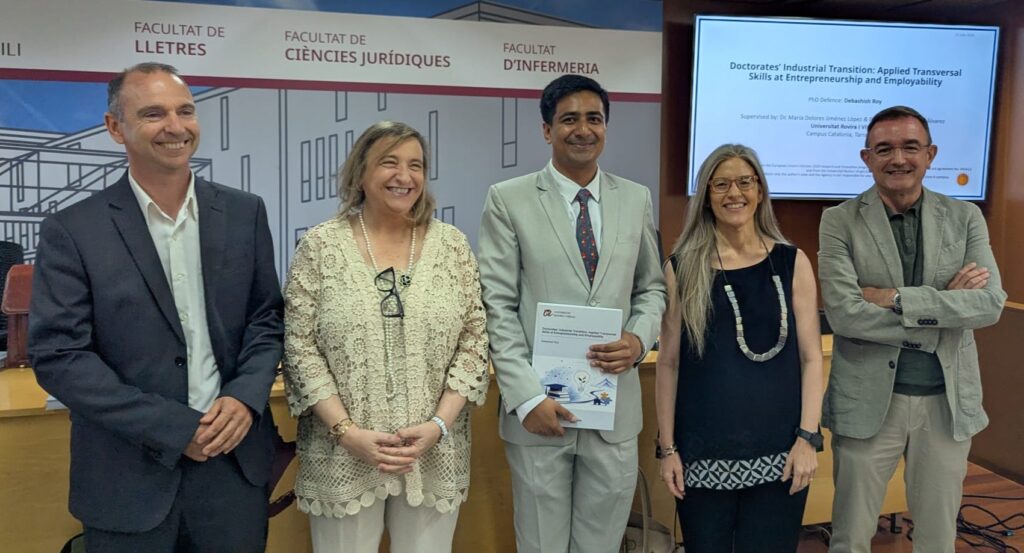
The research proposes a systemic approach to doctoral transition, arguing that the professional success of doctoral degree holders outside academia depends not only on the competencies they develop during their training, but also on the ability of universities, companies and public administrations to recognise, recruit and leverage doctoral talent as a strategic asset for innovation and competitiveness.
As such, the thesis puts forward two complementary competency frameworks. The first is HIRES-PhD, which identifies the transversal competencies that enhance doctoral employability in industrial environments, including communication skills, leadership, interdisciplinary collaboration and the ability to adapt to complex organisational settings. The second is DOCTRINES, which defines the entrepreneurial competencies required to transform scientific knowledge into new business initiatives, incorporating elements such as opportunity recognition, value creation and innovative project development.
Both frameworks offer significant potential for practical application by key actors across the innovation ecosystem. They enable universities to adapt doctoral programmes to labour market needs; help companies identify the added value that doctoral talent brings beyond their scientific expertise; and provide researchers with a reference framework to recognise, develop and communicate the competencies demanded in professional environments.
The thesis also highlights the role of public administrations in designing policies that foster innovation-driven business growth, thus supporting the development of a critical mass of SMEs with sufficient absorptive capacity to recruit doctoral talent and transform knowledge into a competitive advantage.
The impact of the research has extended beyond academia
In January this year, the European Commission selected Debashish Roy as MSCA Fellow of the Month, a distinction awarded to researchers whose projects demonstrate outstanding impact within the Marie Skłodowska-Curie Actions. On the strength of this recognition, Research Ireland invited him to join the panel of experts at the MSCA Presidency Conference 2026, which will take place next November as one of the official events of Ireland’s Presidency of the Council of the European Union. During the session Enabling Resilient and Future-Proofed Research Careers, Roy will join representatives from universities, funding organisations, industry and public policy bodies to discuss how to build more resilient and future-ready research careers, supporting professional pathways that are more diverse and better connected to industry, entrepreneurship and public policy design.
This invitation represents international recognition of the quality and relevance of research carried out at the URV into doctoral employability and entrepreneurship. It also places the thesis’s contributions within the broader European debate on how to facilitate the transition of doctoral talent into industry and innovation, and on the conditions that universities, businesses and public administrations must create to fully harness the potential of doctoral degree holders as drivers of competitiveness and economic development.
