17/07/2026
Two complete rhinoceroses dating back 200,000 years discovered in the Cova de les Teixoneres, Moià
The excavations by the URV and IPHES-CERCA have also found the remains, seemingly intact, of other animals such as a horse, a woolly mammoth and at least three bears
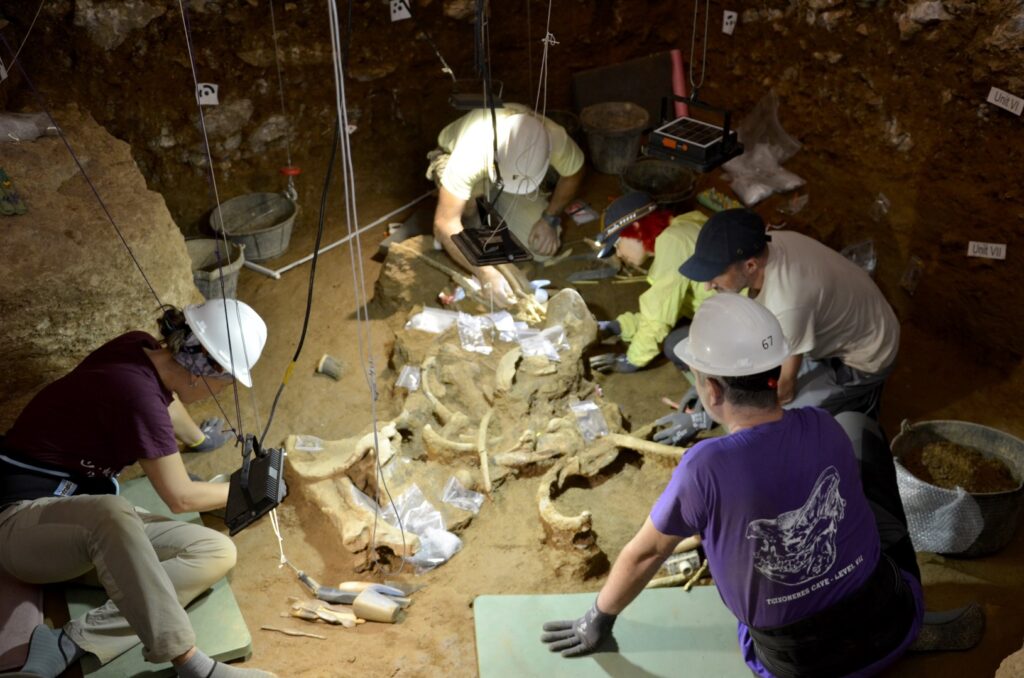
The excavations by the URV and IPHES-CERCA have also found the remains, seemingly intact, of other animals such as a horse, a woolly mammoth and at least three bears
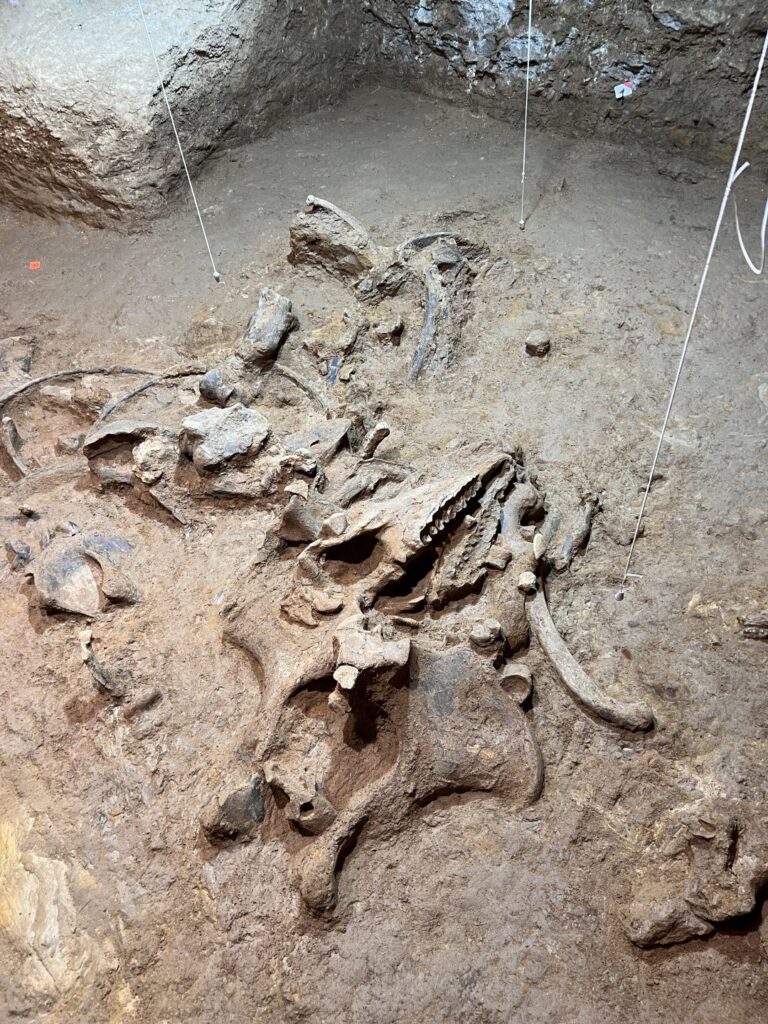
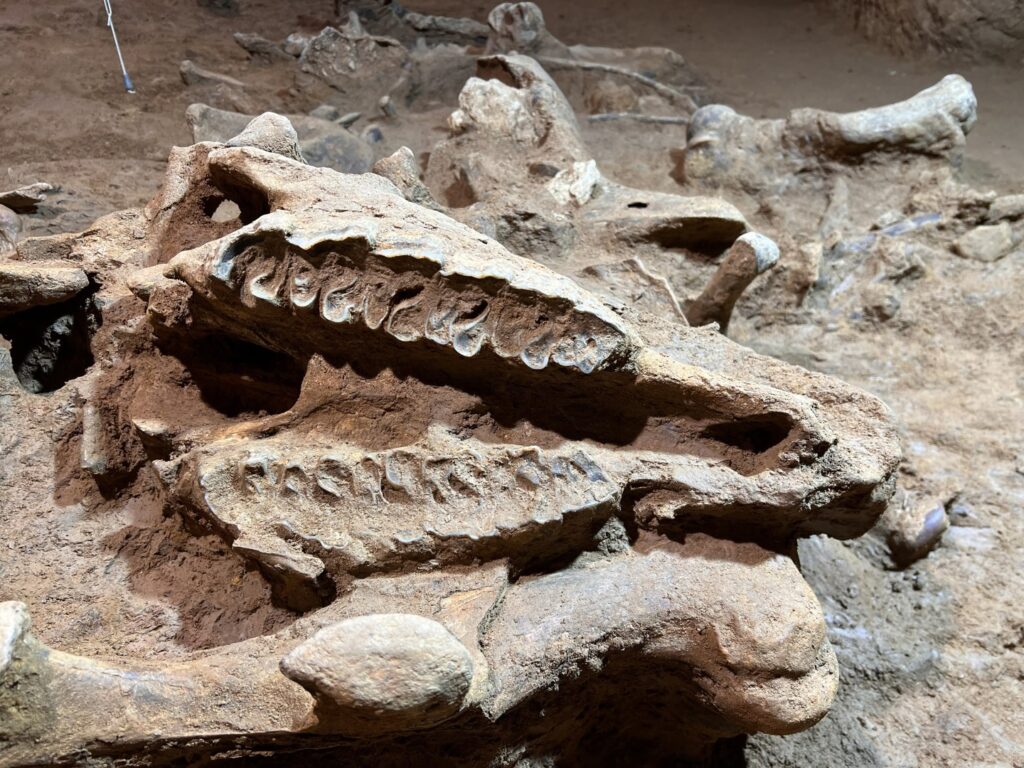
Despite having been excavated for the last 24 years, the Cave of Teixoneres continues to turn up surprises for the archaeologists who work there. This Friday, researchers from the Universitat Rovira i Virgili (URV) and IPHES-CERCA announced their discovery of the remains, which they found during their archaeological dig in the municipality of Moià. This year, their excavations have finally reached the lower strata, dated to 200,000 years old and from which they have recovered a large quantity of bones belonging to large animals. Of particular note are two complete rhinoceros skeletons of the species Stephanorhinus hemitoechus, colloquially known as the steppe rhinoceros. Despite their age, the bones are in an extraordinarily well-preserved condition.
The findings were made public in a presentation involving the project’s principal investigator, Jordi Rosell, from the URV and IPHES-CERCA; the URV’s Vice-Rector Urbano Lorenzo; the Mayor of Moià, Dionís Guiteras; and the Head of the Archaeology and Palaeontology Service of the Catalan Government, Maite Miró.
The rhinoceros skeletons are currently the only ones to have been found on the Iberian Peninsula, and only two other cases have been recorded in Germany and one in Italy. “We still don’t know how these animals got inside the cave,” said Jordi Rosell. “It should be remembered that these animals could weigh over a ton and a half. And from what we have seen during the excavation, some of the bones are in anatomical connection, which means that the bodies probably arrived in the cave long before they began to decompose.” According to the researcher, from what is known of their behaviour, these animals did not typically visit caves, and so he suspects that their presence in the caves at Moià must be due to some other factor. “It is possible they entered because they were attracted by some kind of natural trap such as a waterhole, or their presence might be due to an accidental fall, but so far our investigations have not allowed us to identify the likely cause.”
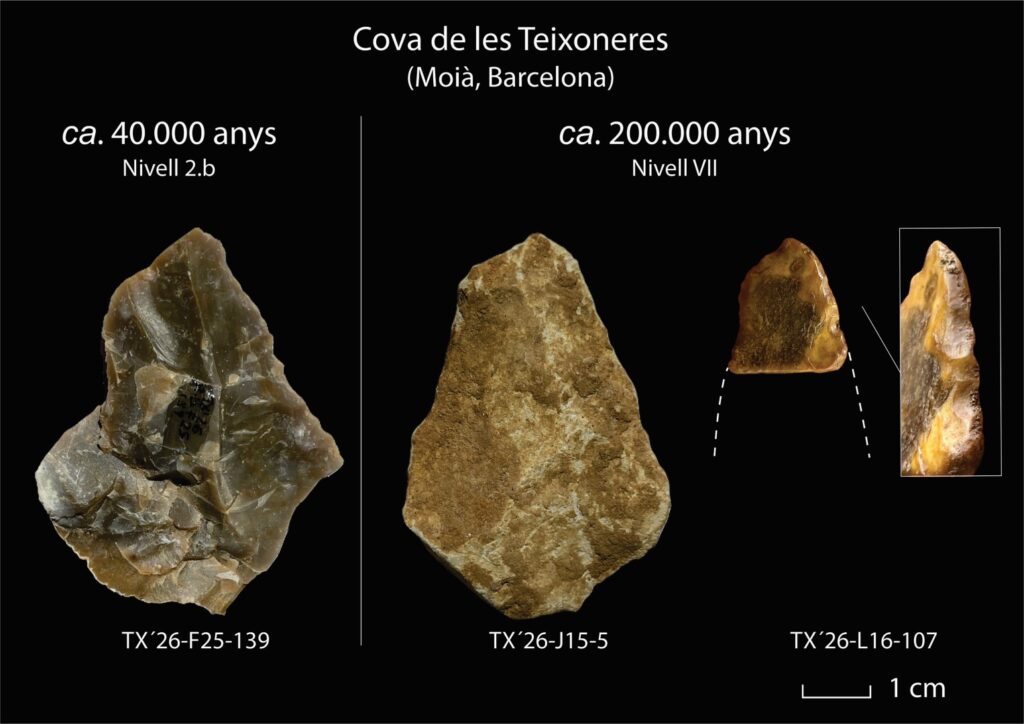
“We have found some lithic tools near the bones, as well as flakes and the fragment of a broken bone point, which represents a type of tool hitherto unknown in this period,” explained Ruth Blasco, a Ramón y Cajal researcher at the IPHES-CERCA. Although it is still too early for the researchers to draw exact conclusions, the good state of preservation of the bones has been surprising, although they are still covered in extraneous material that does not allow the researchers to see their surfaces in detail. “We are convinced that once we have cleaned them, we will be able to determine whether the carcasses were utilised by Neanderthals or by the area’s carnivores, such as hyenas, cave bears or wolves,” she added.
This is the first time that remains of the species Stephanorhinus hemitoechus have been found in the Cova de les Teixoneres. This animal first became abundant in European sites 500,000 years ago and disappeared around 20,000 years ago with the onset of the intense cold of the Last Glacial Maximum. “In the more recent strata we found rhinoceros remains associated with Neanderthal camps,” explained Florent Rivals, ICREA Research Professor at the IPHES. “But those are from the woolly rhinoceros (Coelodonta antiquitatis). The presence of the steppe rhinoceros in the lower layers indicates that there was a succession of climatic changes between 200,000 and 75,000 years ago that were sufficiently severe to cause animals found in temperate climates to be replaced by other forms better adapted to the cold.”
Both the Cova de les Teixoneres and the Cova del Toll are well-known in the worlds of palaeontology and palaeoecology for having been refuges for many species. “The upper strata, that is, those dated between 100,000 and 35,000 years old, present a curious association of animals in which species from very cold climates, such as the mammoth or the woolly rhinoceros, coexist with animals from temperate climates, such as the roe deer,” continued the researcher.
At the back of the cave, specifically in the upper strata, the team has also been excavating the remains of a hearth dated to 40,000 years ago. The cave shows evidence of Neanderthal occupation up to 36,000 years ago, which is when this human species disappeared. “The hearth is associated with remains of eaten animals and some tools,” explained Anna Rufà, a Ramon y Cajal researcher at the IPHES-CERCA. “Interestingly, the lithic industry we have found is very similar to that of the lower strata, which means that this species was able to adapt to the different climatic events of prehistory without substantially changing its technology.”
Parallel to this, the same team has been excavating at the neighbouring Cova del Toll, known to have been a hibernation site for cave bears. “We have also found lithic industry here,” commented Ivan Ramírez, a researcher at the University of Barcelona. “We have long been looking for evidence that can clearly demonstrate that the local Neanderthal groups made use of the carcasses of bears that died during hibernation. The finds recovered this year will add to this evidence and to the debate regarding the hunting of the cave bear during the Middle Palaeolithic.”
The excavations at the Cova del Toll and Cova de les Teixoneres began on 22 June and will end on 22 July. The team consists mainly of members from the URV and IPHES-CERCA, but also includes researchers from the UB, UAB, the Complutense University of Madrid and the Autonomous University of Madrid; the Chinese Academy of Sciences in Beijing; CONICET; the National University of Patagonia SJB, IDEAus-CONICET of Argentina; and the ICArEHB of Portugal.
Funding
The research at the Cova del Toll and the Cova de les Teixoneres is funded by SCAVENGERS project of the European Union and the Department of Culture of the Catalan Government, entitled “Humans and Carnivores in the Middle Palaeolithic: Real Cohabitation or Biased Perception?” and by the project of the Spanish Ministry of Science and Innovation, “Neanderthal behaviour and palaeoecology in Mediterranean ecosystems”, and it receives logistical and financial support from Moià town council.
