26/10/2026
Joan Maria Thomàs: “The regime needed to be understood from within”
The URV professor of History reconstructs the Civil War in the Mallorca of 1936 using 491 previously unpublished letters exchanged by his parents and an exhaustive archival investigation
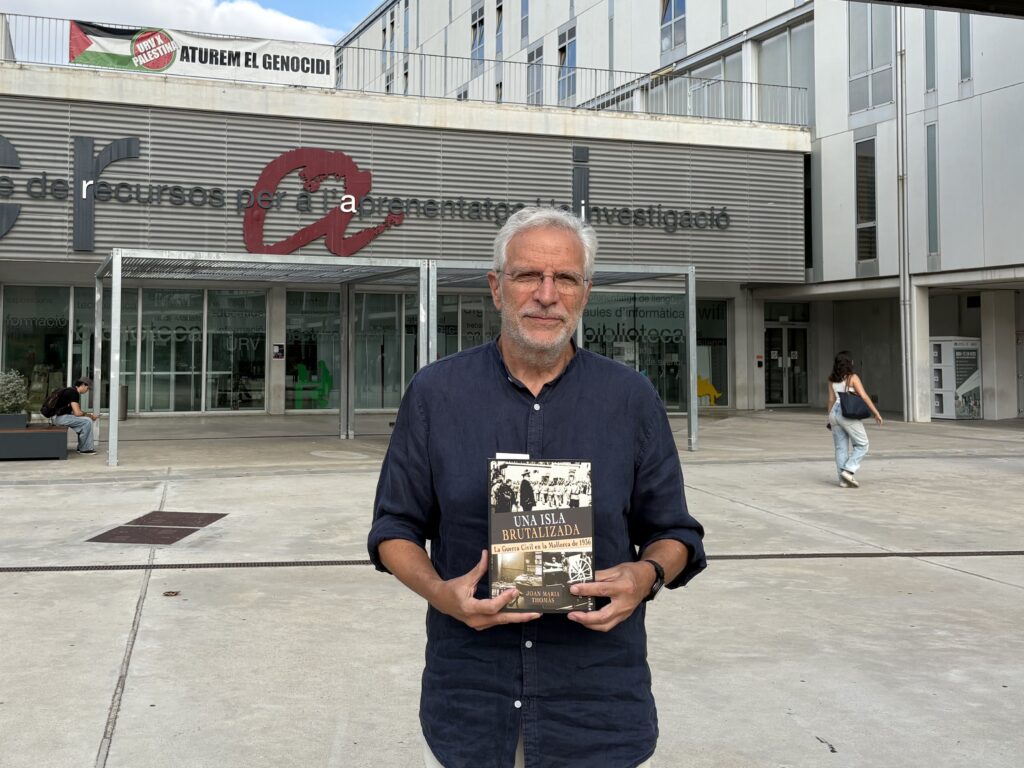
The URV professor of History reconstructs the Civil War in the Mallorca of 1936 using 491 previously unpublished letters exchanged by his parents and an exhaustive archival investigation
After decades dedicated to researching fascism, Catalan Francoism and international relations during the Second World War, the historian Joan Maria Thomàs has decided to look closer to home. His latest book, Una isla brutalizada. La Guerra Civil en la Mallorca de 1936 (A Brutalised Island: The Civil War in the Mallorca of 1936) reconstructs the island’s social and military fracture during the first months of the fratricidal war using a source as intimate as it is exceptional: 491 letters that his parents sent to one another during the conflict.
From romantic correspondence to archival rigour
The author’s starting point was the letters exchanged between two young, upper-middle-class Catholic newlyweds who married in the midst of the war, just before the man (Thomàs’ father) was sent to fight on the Spanish mainland. Rather than just creating a simple memorial to his parents, Thomàs has woven their experiences into an account that also draws on more than two hundred specialised books, archival documentation and a daily review of all the Mallorcan press published during 1936.
By contrasting his parents’ correspondence with these other documentary sources, Thomàs has been able not only to verify the everyday events recounted in the letters, but has also helped to bring back to life the concerns and fears felt by many contemporary women through the missives written by his mother, which are marked by fear, the loneliness of waiting and the birth of her first daughter while her husband was on the front, and by her clashes with the rigid social norms imposed on young women at the time.
Bombings, fighting and double repression
A brutalised island brings together in a single volume four strands that had often been treated in a fragmented manner:
- Land battles: The landing and attempted reconquest by Republican troops and militias from Catalonia and Menorca in August 1936, and their subsequent withdrawal by order of the Madrid government.
- The air and sea front: The strategic role of Mallorca as an air-naval base from which Francoist, German and Italian aircraft bombed the Republican coastline of the peninsula (including cities such as Barcelona and Reus), as well as key events such as the sinking of the cruiser Baleares.
- Political violence: Francoist repression in Mallorca and Republican repression in Menorca, two events that directly affected branches of the author’s own family.
- Cultural repression: The ideological persecution of citizens and organisations with left-wing or Catalanist tendencies.
For Thomàs, one of the most important contributions of his book is that it looks in depth at the motivations of the civilian population that supported the military uprising. “The book attempts to explain why a section of the population, probably the majority in Mallorca, sided with Franco, their motives often being the fear of a revolution, the defence of religion and their horror at the destruction of heritage that they saw happening on the mainland.” But Thomàs also makes clear that “agreeing with that side did not mean that the people agreed with the atrocities or the extrajudicial killings that were committed by them”.
This conflict and the air raids from Barcelona also fuelled a strong anti-Catalan sentiment in the Balearic Islands, often confused with and manifested as rejection of the left-wing republican militias.
For years Thomàs postponed the research because he doubted whether he could maintain methodological rigour in the face of material so closely linked to his own family biography: his father had a career within the Franco regime. “I was reluctant because I doubted my ability to be impartial. But after seeing works by reputable historians who address family matters and reflecting on my own career, where I have always written about figures from the regime from a personal standpoint of opposition, I realised I could do it without worrying”, he explained.
Rigorous resources for new generations
The historian highlights that research on the Civil War has made a notable qualitative leap in recent decades, offering much more scientific and impartial analyses. In this regard, he recommends that readers and interested parties consult specialised academic literature and verified digital tools such as the Virtual Museum of the Spanish Civil War, a platform jointly promoted with other historians to offer verified content in the face of the disinformation circulating on social media.
Thomàs is set to continue his research on the family archive and the Civil War in the Balearics in a second volume that will analyse the trajectory of the Islands during the rest of the conflict, from 1937 until the end of the war in 1939.
